MCQ
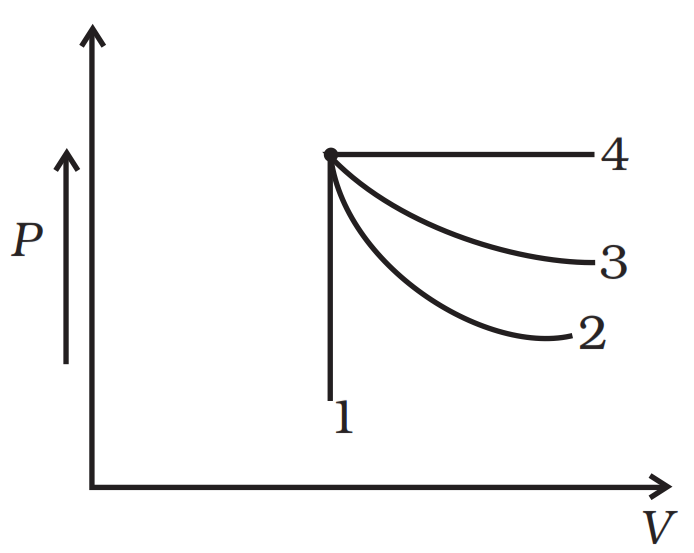
An ideal gas undergoes four different processes from thesame initial state (Fig.). Four processes are adiabatic, isothermal, isobaric and isochoric. Out of 1, 2, 3 and 4 whichone is adiabatic.
  • A
    4
  • B
    3
  • C
    2
  • D
    1

Answer

  1. 2

Explanation:

4 is isobaric process, 1 is isochoric. out of 3 and 2, 3 has the smaller slope (magnitude) hence is isothermal. Remaining process 2 is adiabatic.

Need a full question paper?

Generate a complete, print-ready paper with questions like this in minutes — across 16+ boards, with answer keys.

Start Generating Free

Similar questions

Which of the following quantities is the same for all ideal gases at the same temperature?
An insulated container of gas has two chambers separated by an insulating partition. One of the chambers has volume $V_1$ and contains ideal gas at pressure $P_1$ and temperature $T_1$ . The other chamber has volume $V_2$ and contains ideal gas at pressure $P_2$ and temperature $T_2$. If the partition is removed without doing any work on the gas, the final equilibrium temperature of the gas in the container will be
Dry ice is
A cube of ice has a iron piece fronzen unside at. The cube floats un a beakerfilled with water, when the ice melts then, the level of water in beaker.
Two rods of different materials having coefficient of linear expansion $\alpha_1$and $\alpha_2$ and  Young's modulii $Y_1$ and $Y_2$ respectively are fixed between two rigid massive walls. The rods are heated such that they undergo the same increase in temperature. There is no bending of rods. If  $\alpha_1:\alpha_2= 2 : 3$, the thermal stress developed in two rods are equal provided $Y_1 : Y_2$ is equal to
An artificial satellite is placed into a circular orbit around earth at such a height that it always remains above a definite place on the surface of earth. Its height from the surface of earth is  ........... $km$
An alternating current is given by $\text{i}=\text{i}_1\cos\omega\text{t}+\text{i}_2\sin\omega\text{t}.$ The rms current is given by:

  1. $\frac{\text{i}_1+\text{i}_2}{\sqrt{2}}$

  2. $\frac{|\text{i}_1+\text{i}_2|}{\sqrt{2}}$

  3. $\sqrt{\frac{\text{i}_1^2+\text{i}_2^2}{2}}$

  4. $\sqrt{\frac{\text{i}_1^2+\text{i}_2^2}{\sqrt{2}}}$
A metallic rod of length $I$ and cross-sectional area $A$ is made of a material of Young's modulus $Y$. If the rod is elongated by an amount $y$, then the work done is proportional to ......
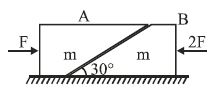
Two blocks $'A$' and $'B'$ each of mass $'m'$ are placed on a smooth horizontal surface. Two horizontal force $F$ and $2F$ are applied on the $2$ blocks $'A'$ and $'B'$ respectively as shown in figure. The block $A$ does not slide on block $B$. Then the normal reaction acting between the two blocks is
A particle of mass $m$ is tied to string of length $l$ and whirled in vertical circle. The difference of tension and kinetic energy at highest and lowest position of circular path will be