MCQ
An ideal thermometer should have
  • A
    Large heat capacity
  • B
    Medium heat capacity
  • Small heat capacity
  • D
    Variable heat capacity

Answer

Correct option: C.
Small heat capacity
c
(c) The thermometer has to attain the temperature of the body. To do this, it should draw as little heat from the body as possible, so that the existing temperature of the body is not disturbed.

Need a full question paper?

Generate a complete, print-ready paper with questions like this in minutes — across 16+ boards, with answer keys.
Start Generating Free

Similar questions

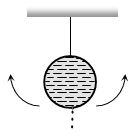
A simple pendulum is made of a body which is a hollow sphere containing mercury suspended by means of a wire. If a little mercury is drained off, the period of pendulum will
A child stands on the edge of the cliff $10\,m$ above the ground and throws a stone horizontally with an initial speed of $5\,ms ^{-1}$. Neglecting the air resistance, the speed with which the stone hits the ground will be $..........ms ^{-1}$ (given, $g =10\,ms ^{-2}$)
There are $100$ divisions on the circular scale of a screw gauge of pitch $1 \mathrm{~mm}$. With no measuring quantity in between the jaws, the zero of the circular scale lies $5$ divisions below the reference line. The diameter of a wire is then measured using this screw gauge. It is found the $4$ linear scale divisions are clearly visible while $60$ divisions on circular scale coincide with the reference line. The diameter of the wire is :
The displacement of a particle is given at time $t$, by:$x=A \sin (-2 \omega t)+B \sin ^2 \omega t \quad$ Then,
If the radius of the earth shrinks by $1.5\%$ (mass remaining same), then the value of acceleration due to gravity changes by ....... $\%$.
The rebound coefficient between a tennis ball and a racket is defined as $g = v_2/ v_1$, where $v_1$ is the incoming speed of the ball and $v_2$ is the speed of the ball after rebound while the racket is at rest. A tennis ball falls from height $H$ to a racket at rest and bounces back to $0.8\  H. A$ tennis player is using the racket to hit an incoming tennis ball traveling at $150\ km/hr$ and the racket is moving at $100\ km/hr$. What is the speed of the ball after being hit? (Assume the mass of the racket >> that of the ball)..........$km/hr$
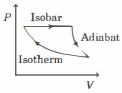
The efficiency of the cycle shown below in the figure (consisting of one isobar, one adiabat and one isotherm) is $50 \%$. The ratio $x$, between the highest and lowest temperatures attained in this cycle obeys (the working substance is an ideal gas)
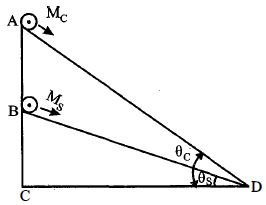
A cylinder of mass $M_c$ and sphere of mass $M_s$ are placed at points $A$ and $B$ of two inclines, respectively (See Figure). If they roll on the incline without sipping such that their accelerations are the same, then the ratio $\frac{{\sin \,{\theta _c}}}{{\sin \,{\theta _s}}}$ is
Dimensional formula for thermal conductivity is (here $K$ denotes the temperature)
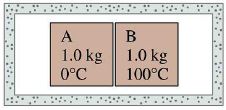
Objects $A$ and $B$ that are initially separated from each other and well isolated from their surroundings are then brought into thermal contact. Initially $T_A= 0^oC$ and $T_B = 100^oC$. The specific heat of $A$ is less than the specific heat of $B$. After some time, the system comes to an equilibrium state. The final temperatures are :