An image $\frac{2}{3}\text{rd}$ the size of object is formed by a convex lens at a distance of 12cm from Find the focal length of the lens.
Download our app for free and get started
$\text{v}=12\text{cm}$For real and inverted image the magnification will be negative.
Therefore, $\text{m}=\frac{-2}{3}$
$\text{m}=\frac{-2}{3},\text{ v}=+12\text{cm}$
$\text{m}=\frac{\text{v}}{\text{u}}=\frac{-2}{3}=\frac{12}{\text{u}}$
$-2\text{u}=36$
$\text{u}=-18\text{cm}$
$\frac{1}{\text{f}}=\frac{1}{\text{v}}-\frac{1}{\text{u}}$
$\frac{1}{\text{f}}=\frac{1}{12}-\frac{1}{-18}=\frac{3+2}{36}$
$\text{f}=\frac{36}{5}=7.2\text{cm}$
Therefore, $\text{m}=\frac{-2}{3}$
$\text{m}=\frac{-2}{3},\text{ v}=+12\text{cm}$
$\text{m}=\frac{\text{v}}{\text{u}}=\frac{-2}{3}=\frac{12}{\text{u}}$
$-2\text{u}=36$
$\text{u}=-18\text{cm}$
$\frac{1}{\text{f}}=\frac{1}{\text{v}}-\frac{1}{\text{u}}$
$\frac{1}{\text{f}}=\frac{1}{12}-\frac{1}{-18}=\frac{3+2}{36}$
$\text{f}=\frac{36}{5}=7.2\text{cm}$

Download our appand get started for free
Experience the future of education. Simply download our apps or reach out to us for more information. Let's shape the future of learning together!No signup needed.*
Similar Questions
- 1View SolutionA man sits in an optician's chair looking into plane mirror which is 2m away from him and views the image of a chart which faces the mirror and is 50cm behind his head. How far away from his eyes does the chart appear to be?
- 2View SolutionMention the types of mirrors used as,
- Rear view mirrors.
- Shaving mirrors.
- 3View SolutionThe two rays chosen for the construction of ray diagram is:
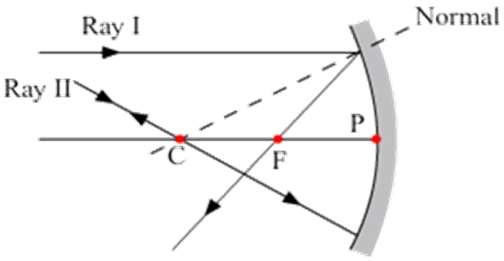
Ray 1: When the incident ray is parallel to the principal axis, the reflected ray will pass through the focus of concave mirror or it appears to pass through the focus of convex mirror.
Ray 2: When the incident ray passes through or appears to pass through the centre of curvature, the light, after reflection from the spherical mirror, reflects back along the same path.
The image formed is real, inverted, magnified and is formed beyond the centre of curvature.
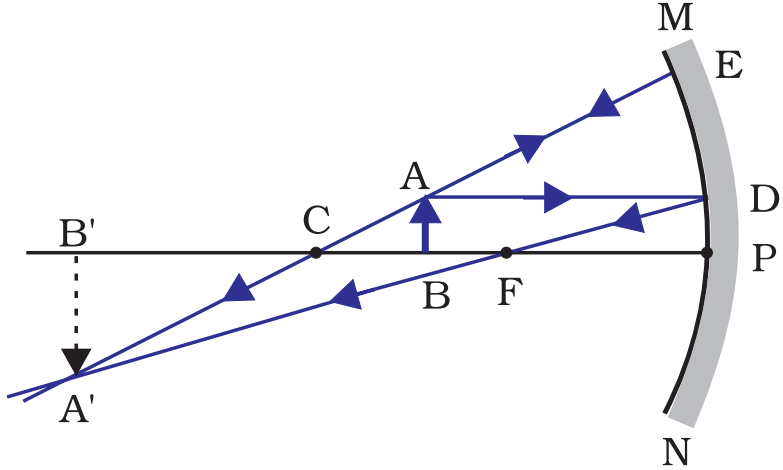
- 4View SolutionA mirror forms an image which is 30cm from an object and twice its height.
- Where must the mirror be situated?
- What is the radius of curvature?
- Is the mirror convex or concave?
- 5View SolutionWhich type of lens is:
- A converging lens, and which is.
- A diverging lens? Explain your answer with diagrams.
- 6View SolutionAn object is placed at a distance of 4cm from a concave lens of focal length 12cm. Find the position and nature of the image.
- 7View SolutionA converging mirror forms a real image of height 4cm of an object of height 1cm placed 20cm away from the mirror:
- Calculate the image distance.
- What is the focal length of the mirror?
- 8View SolutionA 2.0cm tall object is place perpendicular to the principal axis of a concave lens of focal length 15cm. At what distance from the lens, should the object be placed so that it forms an image 10cm from the lens? Also find the nature and the size of image formed.
- 9View SolutionWhy does a ray falling normally on a plane mirror, retrace its path?
- 10View SolutionThe image of an object formed by a lens is of magnification - 1. If the distance between the object and its image is 60 cm, what is the focal length of the lens? If the object is moved 20 cm towards the lens, where would the image be formed? State reason and also draw a ray diagram in support of your answer.