Why does a ray falling normally on a plane mirror, retrace its path?
Download our app for free and get started
The ray traces its path when it falls normally on a plane mirror because the angle of incidence is equal to the angle of reflection. Explanation: According to the 'law of reflection' the angle of 'incidence' is always equals to the "angle of reflection". If a ray falls normally it means it is falling on the 'plane mirror' at right angle. So the 'angle of incidence' is 90 degrees and so is the 'angle of reflection.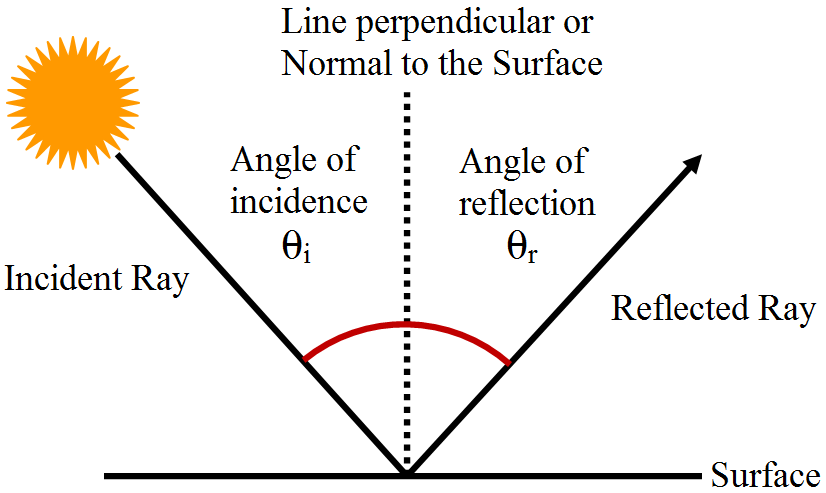

Download our appand get started for free
Experience the future of education. Simply download our apps or reach out to us for more information. Let's shape the future of learning together!No signup needed.*
Similar Questions
- 1View SolutionAn object is placed at a distance equal to 2f in front of a convex lens. Draw a labelled ray diagram to show the formation of image. State two characteristics of the image formed.
- 2View SolutionTwo lenses have powers of (i) +2D and (ii) -4D. What is the nature and focal length of each lens?
- 3View SolutionA concave lens of focal length 15 cm forms an image 10 cm from the lens. How far is the object placed from the lens? Draw the ray diagram.
- 4View SolutionThe image of a candle flame placed at a distance of 45cm from a spherical lens is formed on a screen placed at a distance of 90cm from the lens. Identify the type of lens and calculate its focal length. If the height of the flame is 2cm, find the height of its image.
- 5View SolutionDescribe an activity to show that the colours of white light splinted by a glass prism can be recombined to get white light by another identical glass prism. AIso draw ray diagram to show the recombination of the spectrum of white light.
- 6View SolutionIf the image formed by a lens for all positions of the object placed in front of it is always virtual, erect and diminished, state the type of the lens. Draw a ray diagram in support of your answer. If the numerical value of focal length of such a lens is 20cm, find its power in new cartesian sign conventions.
- 7View SolutionA spherical mirror produces an image of magnification -1.0 on a screen placed at a distance of 30 cm from the pole of the mirror.
- Write the type of mirror in this case.
- What is the focal length of the mirror?
- What is the nature of the image formed?
- Draw the ray diagram to show the image formation in this case.
- 8View SolutionHow far should an object be placed from a convex lens of focal length 20cm to obtain its image at a distance of 30cm from the lens? What will be the height of the image, if the objects is 6cm tall?
- 9View SolutionName the type of mirror used in the following situations.
- Headlights of a car.
- Side/rear-view mirror of a vehicle.
- Solar furnace.
- 10View SolutionTwo lenses A and B have focal lengths of +20cm and, -10cm, respectively.
- What is the nature of lens A and lens B?
- What is the power of lens A and lens B?
- What is the power of combination if lenses A and B are held close together?