Question
An incompressible fluid flows steadily through a cylindrical pipe which has radius $2r$ at point $A $ and radius $r $ at $B $ further along the flow direction. If the velocity at point $A$  is $v, $ its velocity at point $B$  is

Answer

(d) From equation of continuity volume of water entering per second at $\mathrm{A}=$ volume of water exiting per second from $B$

Let $v$ be the velocity at point $B$, then

$\pi(2 R)^{2} v=\pi\left(R^{2}\right) v^{\prime}$

$v^{\prime}=4 v$

Need a full question paper?

Generate a complete, print-ready paper with questions like this in minutes — across 16+ boards, with answer keys.
Start Generating Free

Similar questions

A parallel plate capacitor carries a charge $q$. The distance between the plates is doubled by application of a force. The work done by the force is
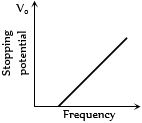
In the graph given below. If the slope is $4.12 \times {10^{ - 15}}$ $V-sec$, then value of $‘h’$ should be
The equation of a circle is given by $x^2+y^2=a^2$, where $a$ is the radius. If the equation is modified to change the origin other than $(0,0)$, then find out the correct dimensions of $A$ and $B$ in a new equation: $(x-A t)^2+\left(y-\frac{t}{B}\right)^2=a^2$.The dimensions of $t$ is given as $\left[ T ^{-1}\right]$.
If a system undergoes contraction of volume then the work done by the system will be
Match the List $I$ with the List $II$ from the combinations shown
$(I)$ Presbiopia $(A)$ Sphero-cylindrical lens
$(II)$ Hypermetropia $(B)$ Convex lens of proper power may be used close to the eye
$(III)$ Astigmatism $(C)$ Concave lens of suitable focal length
$(IV)$ Myopia $(D)$ Bifocal lens of suitable focal length
The ratio of kinetic energy of a planet at perigee and apogee during its motion around the sun in elliptical orbit of eccentricity $e$ is ..........
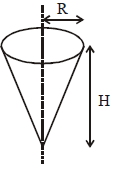
Shown in the figure is a hollow icecream cone (it is open at the top). If its mass is $M,$ radius of its top, $R$ and height, $H$, then its moment of inertia about its axis is
At a certain temperature for given wave length, the ratio of emissive power of a body to emissive power of black body in same circumstances is known as
A tuning fork $A$ of unknown frequency produces $5\, beats/s$ with a fork of known frequency $340\, Hz$. When fork $A$ is filed, the beat frequency decreases to $2\, beats/s.$ What is the frequency of fork $A$ ? (in $Hz$)
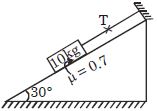
The tension $T$ in the string shown in figure is