At a certain temperature for given wave length, the ratio of emissive power of a body to emissive power of black body in same circumstances is known as
Easy
Download our app for free and get started
(b) By Kirchhoffs law at a certain temperature for given wave length, the ratio of emissive power of a body to emissive power of black body

Download our appand get started for free
Experience the future of education. Simply download our apps or reach out to us for more information. Let's shape the future of learning together!No signup needed.*
Similar Questions
- 1View SolutionThe amount of radiation emitted by a perfectly black body is proportional to
- 2View SolutionIce formed over lakes has
- 3For a small temperature difference between the body and the surroundings the relation between the rate of loss heat $R$ and the temperature of the body is depicted byView Solution
- 4View SolutionOn heating one end of a rod, the temperature of whole rod will be uniform when
- 5Shown below are the black body radiation curves at temperatures $T1$ and $T2$ (T2>T1). Which of the following plots is correctView Solution
- 6For a small temperature difference between the body and the surroundings the relation between the rate of loss heat $R$ and the temperature of the body is depicted byView Solution
- 7Radiation from a black body at the thermodynamic temperature $T_1$ is measured by a small detector at distance $d_1$ from it. When the temperature is increased to $T_2$ and the distance to $d_2$ , the power received by the detector is unchanged . What is the ratio $d_2/d_1$ ?View Solution
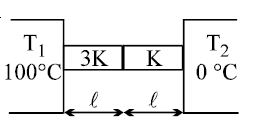
- 8Two rods $A$ and $B$ of same cross-sectional are $A$ and length $l$ connected in series between a source $(T_1 = 100^o C)$ and a sink $(T_2 = 0^o C)$ as shown in figure. The rod is laterally insulated If $G_A$ and $G_B$ are the temperature gradients across the rod $A$ and $B$, thenView Solution
- 9A cup of tea cools from $65.5^o C to 62.5 ^o C$ in one minute in a room of $22.5 ^o C$. How long will the same cup of tea take, in.............. minutes, to cool from $46.50^o C to 40.5 ^o C$ in the same room ? (choose nearest value)View Solution
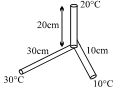
- 10Three rods made of the same material and having same cross-sectional area but different lengths $10\,\,cm$, $\,\,20 cm$ and $30\,\,cm$ are joined as shown. The temperature of the joint is ....... $^oC$View Solution