MCQ
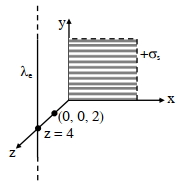
An infinite plane sheet of charge having uniform surface charge density $+\sigma_5 \mathrm{C} / \mathrm{m}^2$ is placed on $\mathrm{x}-\mathrm{y}$ plane. Another infinitely long line charge having uniform linear charge density $+\lambda_e \mathrm{C} / \mathrm{m}$ is placed at $z=4 \mathrm{~m}$ plane and parallel to $y$-axis. If the magnitude values $\left|\sigma_s\right|=2\left|\lambda_{\mathrm{e}}\right|$ then at point $(0,0,2)$, the ratio of magnitudes of electric field values due to sheet charge to that of line charge is $\pi \sqrt{\mathrm{n}}: 1$. The value of $n$ is
  • $16$
  • B
    $20$
  • C
    $23$
  • D
    $30$

Answer

Correct option: A.
$16$
a
$\frac{\mathrm{E}_S}{\mathrm{E}_{\ell}}=\frac{\sigma}{2 \in_0} \times \frac{2 \pi \in_0 \mathrm{r}}{\lambda}$

$=\frac{\pi \times \sigma \mathrm{r}}{\lambda}$

$=\frac{\pi \times 2 \lambda \times 2}{\lambda}=\frac{4 \pi}{1}$

$\therefore \mathrm{n}=16$

Need a full question paper?

Generate a complete, print-ready paper with questions like this in minutes — across 16+ boards, with answer keys.

Start Generating Free

Similar questions

A nucleus moving with a velocity $\vec{\text{v}}$ emits an α-particle. Let the velocities of the α-particle and the remaining nucleus be $\vec{\text{v}}_1$ and $\vec{\text{v}}_2$ and their masses be $m_1$ and $m_2$.
What amount of heat will be generated in a coil of resistance $R$ due to a charge $q$ passing through it if the current in the coil decreases to zero uniformly during a time interval $\Delta t$
Photon of 5.5 eV energy fall on the surface of the metal emitting photoelectrons of maximum kinetic energy 4.0 eV. The stopping voltage required for these electrons are
A wave is propagating in a medium of electric dielectric constant 2 and relative magnetic permeability 50. The wave impedance of such a medium is
Two long straight parallel conductors separated by a distance of 0.5m carry currents of 5A and 8A in the same direction. The force per unit length experienced by each other is
The gravitational force between a $H-$ atom and another particle of mass $m$ will be given by Newton's law $F = G\frac{{M.m}}{{{r^2}}}$ , then
Nucleus a having $Z=17$ and equal number of protons and neutrons has $1.2\,MeV$ binding energy per nucleon.Another nucleus $B$ of $Z=12$ has total $26$ nucleons and $1.8\,MeV$ binding energy per nucleons.The difference of binding energy of $B$ and $A$ will be $...........MeV$.
Energy stored in electromagnetic oscillations is in the form of
An electron moving with speed $v$ and a photon moving with speed $c,$ have same D-Broglie wavelength. The ratio of kinetic energy of electron to that of photon is -
The intensity of electric field required to balance a proton of mass $1.7 \times {10^{ - 27}} kg$ and charge $1.6 \times {10^{ - 19}} C$ is nearly