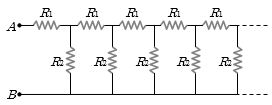
An infinite sequence of resistance is shown in the figure. The resultant resistance between $A$ and $B$ will be, when ${R_1} = 1\,ohm$ and ${R_2} = 2\,ohm$ ............. $\Omega$
Medium


Download our appand get started for free
Experience the future of education. Simply download our apps or reach out to us for more information. Let's shape the future of learning together!No signup needed.*
Similar Questions
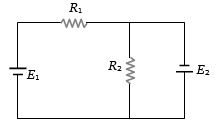
- 1Two resistances ${R_1}$ and ${R_2}$ are joined as shown in the figure to two batteries of $e.m.f.$ ${E_1}$ and ${E_2}$. If ${E_2}$ is short-circuited, the current through ${R_1}$ isView Solution
- 2Voltmeters $V_1$ and $V_2$ are connected in series across a $D.C.$ line. $V_1$ reads $80\, volts$ and has a per volt resistance of $200 \,\Omega$. $V_2$ has a total resistance of $32 \,kilo-ohms$. The line voltage is .............View Solution
- 3An electric kettle has two coils. When one of these is switched on, the water in the kettle boils in $6\,\min$ . When the other coil is switched on, the water boils in $3\,\min$. If the two coils are connected in series, the time taken to boil the water in the kettle is ............. $min$View Solution
- 4The combination of two identical cells, whether connected in series or parallel combination provides the same current through an external resistance of $2 \,\Omega$. The value of internal resistance of each cell is ............ $\Omega$View Solution
- 5The charge flowing through a resistance $R$ varies with time $t$ as $ Q=at-bt^2 $ where $a$ and $b$ are positive constants . The total heat produced in $R$ isView Solution
- 6Two resistances $r_1$ and $r_2\left(r_1 < r_2\right)$ are joined in parallel. The equivalent resistance $R$ is such thatView Solution
- 7View SolutionSpecific resistance of a conductor increases with
- 8A current of $10\, amp$ is passing through a metallic wire of cross sectional area $4 \times 10^{-6}\, m ^{2}$. If the density of the aluminum conductor is $2.7\, gm / cc$ considering aluminum gives $1$ electrons per atom for conduction find the drift speed of the electrons is ......... $\times 10^{-4} \,m / s$ if molecular weight of aluminum is $27 \,gm$.View Solution
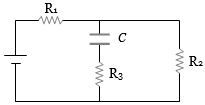
- 9In the circuit here, the steady state voltage across capacitor $C$ is a fraction of the battery $e.m.f.$ The fraction is decided byView Solution
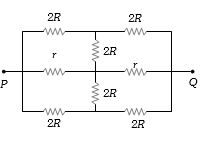
- 10The effective resistance between points $P$ and $Q$ of the electrical circuit shown in the figure isView Solution