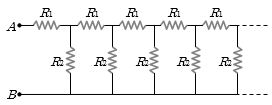
An infinite sequence of resistance is shown in the figure. The resultant resistance between $A$ and $B$ will be, when ${R_1} = 1\,ohm$ and ${R_2} = 2\,ohm$ ............. $\Omega$
Medium


Download our appand get started for free
Experience the future of education. Simply download our apps or reach out to us for more information. Let's shape the future of learning together!No signup needed.*
Similar Questions
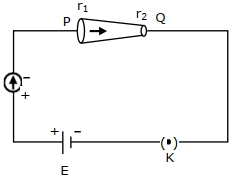
- 1In the given figure, a battery of emf $E$ is connnected across a conductor $P Q$ of length $'Y'$ and different area of cross-sections having radii $r_{1}$ and $r_{2}\left(r_{2}\,<\,r_{1}\right)$.View Solution
Choose the correct option as one moves from $P$ to $Q$ :
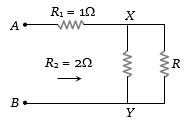
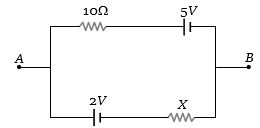
- 2If ${V_{AB}} = 4\,V$ in the given figure, then resistance $X$ will be .............. $\Omega$View Solution
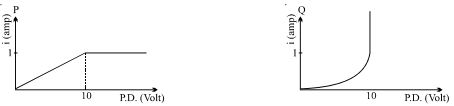
- 3Two current elements $P$ and $Q$ have current voltage characteristics as shown below :View Solution
Which of the graphs given below represents current voltage characteristics when $P$ and $Q$ are in series.
- 4When current supplied by a cell to a circuit is $0.3 \,A$, its terminal potential difference is $0.9 \,V$. When the current supplied becomes $0.25 \,A$, its terminal potential difference becomes $1.0 \,V$. The internal resistance of the cell is ............ $\Omega$View Solution
- 5The resistivity of a potentiometer wire is $40 \times {10^{ - 8}}\,ohm - m$ and its area of cross-section is $8 \times {10^{ - 6}}\,{m^2}$. If $0.2\, amp$ current is flowing through the wire, the potential gradient will beView Solution
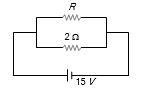
- 6If in the circuit, power dissipation is $150\, W$, then $R$ is ............... $\Omega$View Solution
- 7View SolutionThe drift velocity does not depend upon
- 8The resistance of a $5\, cm$ long wire is $10\, \Omega$. It is uniformly stretched so that its length becomes $20\, cm$. The resistance of the wire is ............. $\Omega$View Solution
- 9In the adjoining circuit, the potential difference across $3\,\,\Omega $ is ................ $\mathrm{V}$View Solution
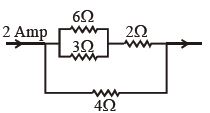
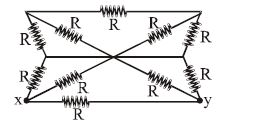
- 10What will be equivalent resistance of circuit between $x$ and $y$View Solution