The drift velocity does not depend upon
Easy


Download our appand get started for free
Experience the future of education. Simply download our apps or reach out to us for more information. Let's shape the future of learning together!No signup needed.*
Similar Questions
- 1A car has a fresh battery of $e.m.f$. $12\, V$ and internal resistance of $0.05\, \Omega$. If the starter motor draws a current of $90\, A$, the terminal voltage when the starter is on will be ............... $V$View Solution
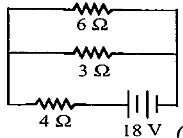
- 2The total power dissipated in watt in the circuit shown here is ............. $W$View Solution
- 3The voltage of clouds is $4 \times 10^6\,volt$ with respect to round. In a lighteing strike lasting $100\,m\,sec$, a charge of $4\,coulombs$ is delivered to the ground. The power of lightening strike isView Solution
- 4If $2.2\, Kwatt$ power is transmitted through a $10\, ohm$ line at $22000\, volt$, the power loss in the form of heat will be ............. $watt$View Solution
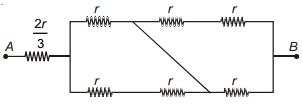
- 5The effective resistance of the network between points $A$ and $B$ isView Solution
- 6By what percentage will the illumination of the lamp decrease if the current drops by $20 \%$ ?View Solution
- 7A wire of resistance $160\,\Omega$ is melted and drawn in wire of one-fourth of its length. The new resistance of the wire will be $......\Omega$View Solution
- 8Forty electric bulbs are connected in series across a $220\, V$ supply. After one bulb is fused, the remaining $39$ are connected again in series across the same supply. The illumination will beView Solution
- 9The current in a conductor is expressed as $I=3 t^2+4 t^3$, where $I$ is in Ampere and $t$ is in second. The amount of electric charge that flows through a section of the conductor during $t=1$ s to $t=2 \mathrm{~s}$ is_______ C.View Solution
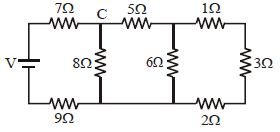
- 10In the ladder network shown, current through the resistor $3\, \Omega$ is $0.25\,A$. The input voltage $'V'$ is equal to:- ........... $V$View Solution