MCQ
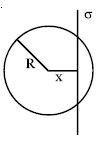
An infinite, uniformly charged sheet with surface charge density $\sigma$ cuts through a spherical Gaussian surface of radius $R$ at a distance $x$ from its center, as shown in the figure. The electric flux $\Phi $ through the Gaussian surface is
  • A
    $\frac{{\pi {R^2}\sigma }}{{{\varepsilon _0}}}$
  • B
    $\frac{{2\pi {{\left( {{R^2} - {x^2}} \right)}^{}}\sigma }}{{{\varepsilon _0}}}$
  • C
    $\frac{{\pi {{\left( {R - x} \right)}^2}\sigma }}{{{\varepsilon _0}}}$
  • $\frac{{\pi {{\left( {{R^2} - {x^2}} \right)}^{}}\sigma }}{{{\varepsilon _0}}}$
Answer

Correct option: D.
$\frac{{\pi {{\left( {{R^2} - {x^2}} \right)}^{}}\sigma }}{{{\varepsilon _0}}}$
d
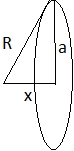
Here the infinite sheet inside the spherical Gaussian surface is a circular sheet of radius

$a=\sqrt{R^{2}-x^{2}}$

using Gauss's law, the electric flux, $\phi=\frac{Q_{\text {enclosed }}}{\epsilon_{0}}$

here, $Q_{\text {enclosed}}=\pi a^{2} \sigma=\pi\left(R^{2}-x^{2}\right) \sigma$

thus, $\phi=\frac{\pi\left(R^{2}-x^{2}\right) \sigma}{\epsilon_{0}}$

Need a full question paper?

Generate a complete, print-ready paper with questions like this in minutes — across 16+ boards, with answer keys.

Start Generating Free

Similar questions

A particle is executing $SHM$ with amplitude $A,$ time period $T,$ maximum acceleration $a_o$ and maximum velocity $v_0.$ Its starts from mean position at $t=0$ and at time $t,$ it has the displacement $A/2,$ acceleration $a$ and velocity $v$ then
An electron moves with speed $2 \times {10^5}\,m/s$ along the positive $x$-direction in the presence of a magnetic induction $B = \hat i + 4\hat j - 3\hat k$ (in $Tesla$) The magnitude of the force experienced by the electron in Newton's is (charge on the electron =$1.6 \times {10^{ - 19}}C)$
A tunnel has been dug through the centre of the earth and a ball is released in it. It will reach the other end of the tunnel after
When a beam of white light is allowed to pass through convex lens parallel to principal axis, the different colours of light converge at different point on the principle axis after refraction. This is called:
A person goes $10\, km$ north and $20\, km$ east. What will be displacement from initial point........$km$
The least count of a stop watch is $0.2\, second$. The time of $20\, oscillations$ of a pendulum is measured to be $25\, second$. The percentage error in the measurement of time will be  ........ $\%$
Each of the two strings of length $51.6\,\, cm$ and $49.1\,\,  cm$ are tensioned separately by $20\,\, N$ force. Mass per unit length of both the strings is same and equal to $1\,\, g/m.$ When both the strings vibrate simultaneously the number of beats is
The height at which the acceleration due to gravity becomes $\frac{g}{9}$ (where $g$ = the acceleration due to gravity on the surface of the earth) in terms of $R$, the radius of the earth, is
A concave mirror of focal length $f$ (in air) is immersed in water ($\mu = 4/3$). The focal length of the mirror in water will be
Three point particles $P, Q, R$ move in circle of radius $‘r’$ with different but constant speeds. They start moving at $t = 0$ from their initial positions as shown in the figure. The angular velocities (in rad/ sec) of $P, Q$ and $R$ are $5\pi , 2\pi$ & $3\pi$ respectively, in the same sense. The time interval after which they are at same angular position.