Question
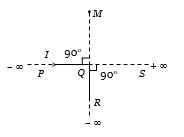
An infinitely long conductor $PQR$ is bent to form a right angle as shown. A current $I$ flows through $PQR$ The magnetic field due to this current at the point $M $ is $H_1$. Now another infinitely long straight conductor $QS$ is connected at $Q$ so that the current is $I/2$ in $QR$ as well as in $QS$, The current in $PQ$ remaining unchanged. The magnetic field at $M$ is now ${H_{2.}}$The ratio ${H_1}/{H_2}$ is given by

Answer

(c) Magnetic field at any point lying on the current carrying straight conductor is zero.
Here $H_1$ = Magnetic field at $M$ due to current in $PQ$.

$H_2$ = Magnetic field at $M$ due to $QR$ + magnetic field at $M$ due to $QS$ + magnetic field at $M$ due to $PQ$

$ = 0 + \frac{{{H_1}}}{2} + {H_1} = \frac{3}{2}{H_1}$

$==>$$\frac{{{H_1}}}{{{H_2}}} = \frac{2}{3}$

Need a full question paper?

Generate a complete, print-ready paper with questions like this in minutes — across 16+ boards, with answer keys.

Start Generating Free

Similar questions

The equation of the stationary wave is

$y = 2A\,\,\sin \,\left( {\frac{{2\pi ct}}{\lambda }} \right)\,\cos \,\,\,\left( {\frac{{2\pi x}}{\lambda }} \right)$

Which statement is not true?

The insulated spheres of radii ${R_1}$ and ${R_2}$ having charges ${Q_1}$and ${Q_2}$ respectively are connected to each other. There is
The electric potential $V$ at any point $O$ ($x$, $y$, $z$ all in metres) in space is given by $V = 4{x^2}\,volt$. The electric field at the point $(1m,\,0,\,2m)$ in $volt/metre$ is
In a $YDSE$ apparatus, two identical slits are separated by $1\, mm$ and distance between slits and screen is $1\, m$. The wavelength of light used is $6000\, Å$. The minimum distance between two points on the screen having $75\%$ intensity of the maximum intensity is ......$mm$
The principle of conservation of linear momentum can be strictly applied during a collision between two particles provided the time of impact is
Photoelectric effect was successfully explained first by
A force $(\vec F) = 3\hat i + c\hat j + 2\hat k$ acting on a particle causes a displacement: $(\vec s)\, = - 4\hat i + 2\hat j + 3\hat k$ in its own direction. If the work done is $6\,J,$ then the value of $'c'$is
Three resistors are connected to form the sides of a triangle $ABC$, the resistance of the sides $AB$, $BC$ and $CA$ are $40\,ohms$, $60\,ohms$ and $100\,ohms$ respectively. The effective resistance between the points $A$ and $B$ in $ohms$ will be
The amplitude and the periodic time of a $S.H.M.$ are $ 5\,cm$ and $6\,sec$ respectively. At a distance of $2.5\,cm$ away from the mean position, the phase will be
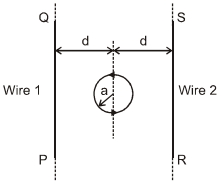
The figure shows a circular loop of radius a with two long parallel wires (numbered $1$ and $2$) all in the plane of the paper. The distance of each wire from the centre of the loop is $d$. The loop and the wires are carrying the same current $I$. The current in the loop is in the counterclockwise direction if seen from above.$Image$

$1.$ When $d \approx$ a but wires are not touching the loop, it is found that the net magnetic filed on the axis of the loop is zero at a height $h$ above the loop. In that case

$(A)$ current in wire $1$ and wire $2$ is the direction $P Q$ and $R S$, respectively and $h \approx a$

$(B)$ current in wire $1$ and wire $2$ is the direction $PQ$ and $SR$, respectively and $h \approx a$

$(C)$ current in wire $1$ and wire $2$ is the direction $PQ$ and $SR$, respectively and $h \approx 1.2 a$

$(D)$ current in wire $1$ and wire $2$ is the direction $PQ$ and $RS$, resepectively and $h \approx 1.2 a$

$2.$ Consider $d \gg a$, and the loop is rotated about its diameter parallel to the wires by $30^{\circ}$ from the position shown in the figure. If the currents in the wires are in the opposite directions, the torque on the loop at its new position will be (assume that the net field due to the wires is constant over the loop)

$(A)$ $\frac{\mu_0 I^2 a^2}{d}$ $(B)$ $\frac{\mu_0 I^2 a^2}{2 d}$ $(C)$ $\frac{\sqrt{3} \mu_0 I^2 a^2}{d}$ $(D)$ $\frac{\sqrt{3} \mu_0 I^2 a^2}{2 d}$

Give the answer question $1$ and $2.$