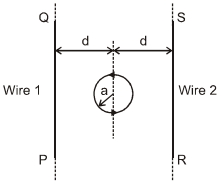
The figure shows a circular loop of radius a with two long parallel wires (numbered $1$ and $2$) all in the plane of the paper. The distance of each wire from the centre of the loop is $d$. The loop and the wires are carrying the same current $I$. The current in the loop is in the counterclockwise direction if seen from above.$Image$

$1.$ When $d \approx$ a but wires are not touching the loop, it is found that the net magnetic filed on the axis of the loop is zero at a height $h$ above the loop. In that case

$(A)$ current in wire $1$ and wire $2$ is the direction $P Q$ and $R S$, respectively and $h \approx a$

$(B)$ current in wire $1$ and wire $2$ is the direction $PQ$ and $SR$, respectively and $h \approx a$

$(C)$ current in wire $1$ and wire $2$ is the direction $PQ$ and $SR$, respectively and $h \approx 1.2 a$

$(D)$ current in wire $1$ and wire $2$ is the direction $PQ$ and $RS$, resepectively and $h \approx 1.2 a$

$2.$ Consider $d \gg a$, and the loop is rotated about its diameter parallel to the wires by $30^{\circ}$ from the position shown in the figure. If the currents in the wires are in the opposite directions, the torque on the loop at its new position will be (assume that the net field due to the wires is constant over the loop)

$(A)$ $\frac{\mu_0 I^2 a^2}{d}$ $(B)$ $\frac{\mu_0 I^2 a^2}{2 d}$ $(C)$ $\frac{\sqrt{3} \mu_0 I^2 a^2}{d}$ $(D)$ $\frac{\sqrt{3} \mu_0 I^2 a^2}{2 d}$

Give the answer question $1$ and $2.$
IIT 2014, Advanced
Download our app for free and get startedPlay store
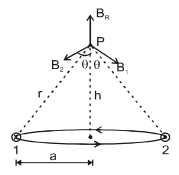
$1.$ $\vec{B}_R=\vec{B}$ due to ring

$\vec{B}_1=\vec{B}$ due to wire $-1$

$\vec{B}_2=\vec{B}$ due to wire $-2$

In magnitudes $B _1= B _2=\frac{\mu_0 I }{2 \pi r }$

Resultant of $B _1$ and $B _2=2 B _1 \cos \theta=\frac{\mu_0 Ia }{\pi \pi^2}$

$B _{ R }=\frac{2 \mu_0 I a ^2}{4 \pi r ^3}$

For zero magnetic field at $P$

$\frac{\mu_0 Ia }{\pi r ^2}=\frac{2 \mu I \pi a ^2}{4 \pi r ^3} $

$\Rightarrow h \approx 1.2 a$

$Image$

$2.$ Magnetic field at mid point of two wires $=\frac{\mu_0 I }{\pi d } \otimes $

Magnetic moment of loop $= I a ^2 $

Torque on loop $= MB \sin 150^{\circ} $

$\qquad=\frac{\mu_0 I ^2 a ^2}{2 d }$

art

Download our app
and get started for free

Experience the future of education. Simply download our apps or reach out to us for more information. Let's shape the future of learning together!No signup needed.*

Similar Questions

  • 1
    Which of the following gives the value of magnetic field according to, Biot-Savart’s law’
    View Solution
  • 2
    A conducting loop carrying a current $I$ is placed in a uniform magnetic field pointing into the plane of the paper as shown. The loop will have a tendency to
    View Solution
  • 3
    A straight section $PQ$ of a circuit lies along the $X$-axis from $x = - \frac{a}{2}$ to $x = \frac{a}{2}$ and carries a steady current $i$. The magnetic field due to the section $PQ$ at a point $X = + a$ will be
    View Solution
  • 4
    A long straight wire of circular cross-section (radius $a$) is carrying steady current $I$. The current $I$ is uniformly distributed across this cross-section. The magnetic field is
    View Solution
  • 5
    An electron having charge $1.6 \times {10^{ - 19}}\,C$ and mass $9 \times {10^{ - 31}}\,kg$ is moving with $4 \times {10^6}\,m{s^{ - 1}}$ speed in a magnetic field $2 \times {10^{ - 1}}\,tesla$ in a circular orbit. The force acting on electron and the radius of the circular orbit will be
    View Solution
  • 6
    Two long straight conductors with currents $I_1$ and $I_2$ are placed along $X$ and $Y-$ axes. The equation of locus of points of zero magnetic induction is 
    View Solution
  • 7
    A coil having $100$ turns, area of $5 \times 10^{-3} \mathrm{~m}^2$, carrying current of $1 \mathrm{~mA}$ is placed in uniform magnetic field of $0.20 \mathrm{~T}$ such a way that plane of coil is perpendicular to the magnetic field. The work done in turning the coil through $90^{\circ}$ is . . . . . . $\mu \mathrm{J}$.
    View Solution
  • 8
    If $ m$ is magnetic moment and $B$ is the magnetic field, then the torque is given by
    View Solution
  • 9
    Two galvanometers $A$ and $B$ require $3\,mA$ and $5\,mA$ respectively to produce the same deflection of $10$ divisions. Then
    View Solution
  • 10
    Two long straight parallel conductors separated by a distance of $0.5\,m$ carry currents of $5\,A$ and $8\,A$ in the same direction. The force per unit length experienced by each other is
    View Solution