MCQ
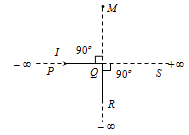
An infinitely long conductor PQR is bent to form a right angle as shown. A current I flows through PQR The magnetic field due to this current at the point M is $H_1$. Now another infinitely long straight conductor QS is connected at Q so that the current is I/2 in QR as well as in QS, The current in PQ remaining unchanged. The magnetic field at M is now $H_2$. The ratio $H_1/H_2$ is given by
  • A
    $\frac{1}{2}$
  • B
    1
  • $\frac{2}{3}$
  • D
    2

Answer

Correct option: C.
$\frac{2}{3}$
(c) $\frac{2}{3}$

Need a full question paper?

Generate a complete, print-ready paper with questions like this in minutes — across 16+ boards, with answer keys.

Start Generating Free

Similar questions

Two lenses of power + 12 and – 2 diopters are placed in contact. The combined focal length of the combination will be
A letter $'A'$ is constructed of a uniform wire with resistance $1.0\,\Omega $ per $cm$ , The sides of the letter are $20\, cm$ and the cross piece in the middle is $10\, cm$ long. The apex angle is $60$ . The resistance between the ends of the legs is close to ................ $\Omega$
An electron is released from rest in a region of space with a non-zero electric field. Which of the following statements is true?
Two points separated by $0.05 \,mm$ can just be inspected in a microscope when light of wavelength $6000 \,\mathring A$ is used. If light of wavelength $3000 \,\mathring A$ is used then the limit of resolution becomes ........... $mm$
A sphere is rotating about a diameter:
Two sources of waves are called coherent if
The minimum wavelength of the X-rays produced by electrons accelerated through a potential difference of V volts is directly proportional to
In amplitude modulation, sinusoidal carrier frequency used is denoted by ${\omega _c}$ and the signal frequency is denoted by ${\omega _m}$ The bandwidth ($\Delta {\omega _m}$) of the signal is such that $\Delta {\omega _m}$ $< <$ ${\omega _c}$ . Which of the following frequencies is not contained in the modulated wave ?
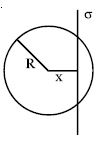
An infinite, uniformly charged sheet with surface charge density $\sigma$ cuts through a spherical Gaussian surface of radius $R$ at a distance $x$ from its center, as shown in the figure. The electric flux $\Phi $ through the Gaussian surface is
At the magnetic north pole of the earth, the value of the horizontal component of earth’s magnetic field and angle of dip are respectively: