MCQ
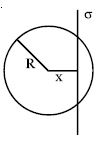
An infinite, uniformly charged sheet with surface charge density $\sigma$ cuts through a spherical Gaussian surface of radius $R$ at a distance $x$ from its center, as shown in the figure. The electric flux $\Phi $ through the Gaussian surface is
  • A
    $\frac{{\pi {R^2}\sigma }}{{{\varepsilon _0}}}$
  • B
    $\frac{{2\pi {{\left( {{R^2} - {x^2}} \right)}^{}}\sigma }}{{{\varepsilon _0}}}$
  • C
    $\frac{{\pi {{\left( {R - x} \right)}^2}\sigma }}{{{\varepsilon _0}}}$
  • $\frac{{\pi {{\left( {{R^2} - {x^2}} \right)}^{}}\sigma }}{{{\varepsilon _0}}}$
Answer

Correct option: D.
$\frac{{\pi {{\left( {{R^2} - {x^2}} \right)}^{}}\sigma }}{{{\varepsilon _0}}}$
d
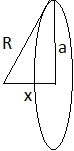
Here the infinite sheet inside the spherical Gaussian surface is a circular sheet of radius

$a=\sqrt{R^{2}-x^{2}}$

using Gauss's law, the electric flux, $\phi=\frac{Q_{\text {enclosed }}}{\in_{0}}$

here, $Q_{\text {enclosed}}=\pi a^{2} \sigma=\pi\left(R^{2}-x^{2}\right) \sigma$

thus, $\phi=\frac{\pi\left(R^{2}-x^{2}\right) \sigma}{\in_{0}}$

Need a full question paper?

Generate a complete, print-ready paper with questions like this in minutes — across 16+ boards, with answer keys.

Start Generating Free