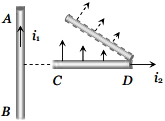
An infinitely long straight conductor $AB$ is fixed and a current is passed through it. Another movable straight wire $CD$ of finite length and carrying current is held perpendicular to it and released. Neglect weight of the wire
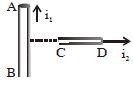
AThe rod $CD$ will move upwards parallel to itself
BThe rod $CD$ will move downwards parallel to itself
CThe rod $CD$ will move upward and turn clockwise at the same time
DThe rod $CD$ will move upward and turn anti-clockwise at the same time
Easy
Download our app for free and get started
CThe rod $CD$ will move upward and turn clockwise at the same time
c since the force on the rod $\mathrm{CD}$ is non-uniform it will experience force and torque. From the left hand side it can be seen that the force will be upward and torque is clockwise.
Download our app
and get started for free
Experience the future of education. Simply download our apps or reach out to us for more information. Let's shape the future of learning together!No signup needed.*
A coil having $N$ turns is wound tightly in the form of a spiral with inner and outer radii $a$ and $b$ respectively. When a current $i$ passes through the coil, the magnetic field at the centre is
A uniform beam of positively charged particles is moving with a constant velocity parallel to another beam of negatively charged particles moving with the same velocity in opposite direction separated by a distance $d.$ The variation of magnetic field $B$ along a perpendicular line draw between the two beams is best represented by
A mass spectrometer is a device which select particle of equal mass. An iron with electric charge $q > 0$ and mass $m$ starts at rest from a source $S$ and is accelerated through a potential difference $V$. It passes $\rho$ through a hole into a region of constant magnetic field $\vec B\,$ perpendicular to the plane of the paper as shown in the figure. The particle is deflected by the magnetic field and emerges through the bottom hole at a distance $d$ from the top hole. The mass of the particle is
Two straight infinitely long current carrying wires are kept along $z-$ axis at the coordinates $(0, a, 0)$ and $(0, -a, 0)$ respectively as shown in the figure. The current in each of the wire is equal and along negative $z-$ axis (into the plane of the paper). The variation of magnetic field on the $x-$ axis will be approximately
An electron is moving with a speed of ${10^8}\,m/\sec $ perpendicular to a uniform magnetic field of intensity $B$. Suddenly intensity of the magnetic field is reduced to $B/2$. The radius of the path becomes from the original value of $r$
A wire carrying current $I$ has the shape as shown in adjoining figure.Linear parts of the wire are very long and parallel to $X-$axis while semicircular portion of radius $R$ is lying in $Y-Z$ plane. Magnetic field at point $O$ is