Question
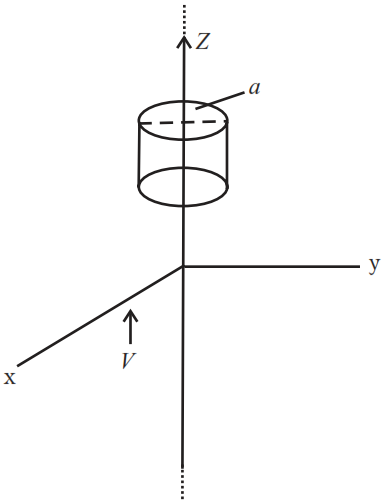
An infinitely long thin wire carrying a uniform linear static charge density λ is placed along the z-axis. The wire is set into motion along its length with a uniform velocity $\text{v}=\text{v}\hat{\text{k}}_\text{z}$. Calculate the poynting vector $\text{S}=\frac{1}{\mu_0}(\text{E}\times\text{B})$.
Answer

The electric field due to infinitely long thin wire
$\vec{\text{E}}=\frac{\lambda\hat{\text{e}}_\text{s}}{2\pi\in_0\text{a}}\hat{\text{j}}$
Magnetic field due to the wire, $\vec{\text{B}}=\frac{\mu_0\text{i}}{2\pi\text{a}}\hat{\text{i}}$
Equivalent current flowing through the wire, $\text{i}=\lambda\text{v}$
Hence $\vec{\text{B}}=\frac{\mu_0\lambda\text{v}}{2\pi\text{v}}\hat{\text{i}}$
$\therefore\ \vec{\text{S}}=\frac{1}{\mu_0}\big[\vec{\text{E}}\times\vec{\text{B}}\big]=\frac{1}{\mu_0}\bigg[\frac{\lambda}{2\pi\in_0\text{a}}\hat{\text{j}}\times\frac{\mu_0\lambda\text{v}}{2\pi\text{a}}\hat{\text{i}}\bigg]$
$\Rightarrow\ \vec{\text{S}}=\frac{\lambda^2\text{v}}{4\pi^2\in_0\text{a}^2}(\hat{\text{j}}\times\hat{\text{i}})=-\frac{\lambda^2\text{v}}{4\pi^2\in_0\text{a}^2}\hat{\text{k}}$

Need a full question paper?

Generate a complete, print-ready paper with questions like this in minutes — across 16+ boards, with answer keys.

Start Generating Free

Similar questions

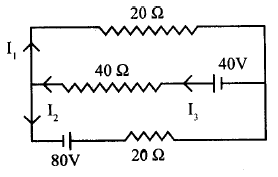
State Kirchhoff's rules of current distribution in an electrical network. Using these rules determine the value of the current I1 in the electric circuit given below.
How long can an electric lamp of 100W be kept glowing by fusion of 2.0 kg of deuterium? Take the fusion reaction as:
$^2_1\text{H}+^2_1\text{H}\rightarrow\ ^3_2\text{He}+\text{n}+3.27\text{ MeV}$
Assume that the mass of a nucleus is approximately given by $M = Am_p$ where A is the mass number. Estimate the density of matter in kg/m$^3$ inside a nucleus. What is the specific gravity of nuclear matter?
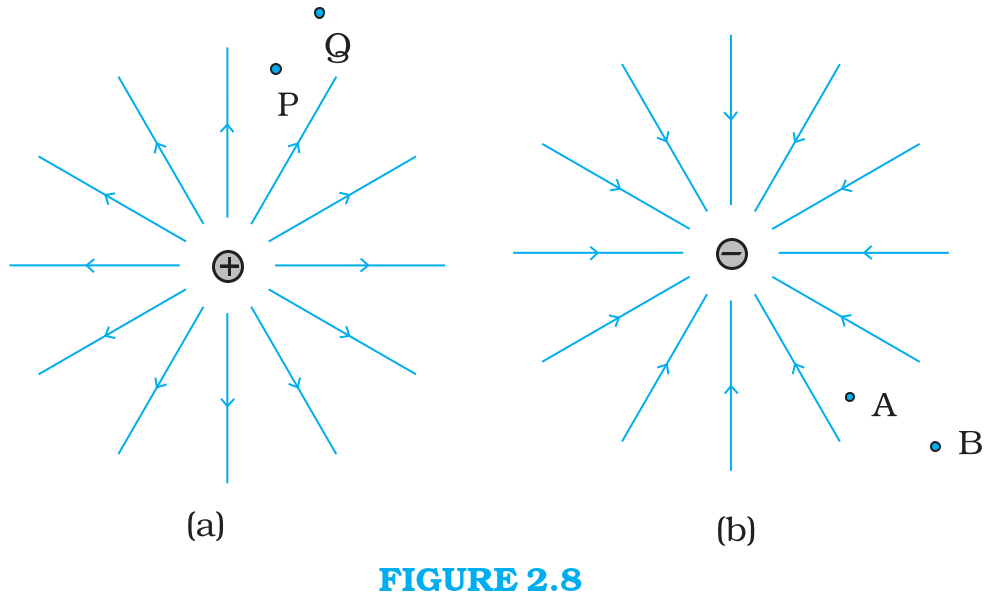
Figures 2.8 (a) and (b) show the field lines of a positive and negative point charge respectively.
Image
(a) Give the signs of the potential difference $V_{ P }-V_{ Q } ; V_{ B }-V_{ A }$.
(b) Give the sign of the potential energy difference of a small negative charge between the points $O$ and $P ; A$ and $B$.
(c) Give the sign of the work done by the field in moving a small positive charge from $Q$ to $P$.
(d) Give the sign of the work done by the external agency in moving a small negative charge from $B$ to $A$.
(e) Does the kinetic energy of a small negative charge increase or decrease in going from $B$ to $A$ ?
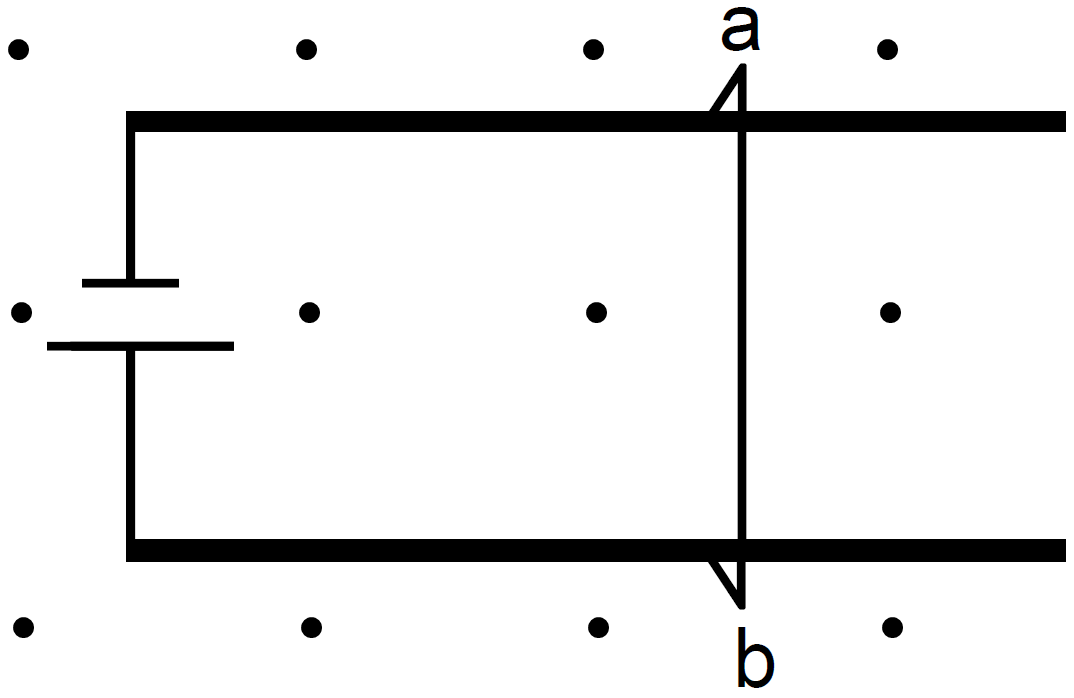
Figure shows a smooth pair of thick metallic rails connected across a battery of emf $\in$ having a negligible internal resistance. A wire ab of length l and resistance r can slide smoothly on the rails. The entire system lies in a horizontal plane and is immersed in a uniform vertical magnetic field B. At an instant t, the wire is given a small velocity u towards right.
  1. Find the current in it at this instant. What is the direction of the current?
  2. What is the force acting on the wire at this instant?
  3. Show that after some time the wire ab will slide with a constant velocity. Find this velocity.
Suppose a monochromatic X-ray beam of wavelength 100pm is sent through a Young's double slit and the interference pattern is observed on a photographic plate placed 40cm away from the slit. What should be the separation between the slits so that the successive maxima on the screen are separated by a distance of 0.1mm?
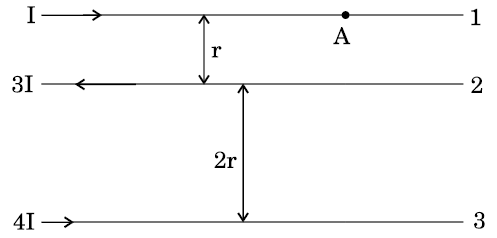
The figure shows three infinitely long straight parallel current carrying conductors. Find the
  1. magnitude and direction of the net magnetic field at point A lying on conductor 1,
  2. magnetic force on conductor 2.
Average lifetime of a hydrogen atom excited to n = 2 state is $10^{-8}s$. Find the number of revolutions made by the electron on the average before it jumps to the ground state.
A small piece of wood is floating on the surface of a 2.5m deep lake. Where does the shadow form on the bottom when the sun is just setting? Refractive index of water $=\frac{4}{3}.$

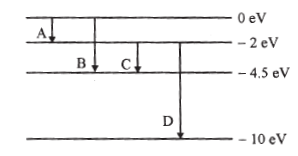
The energy levels of a hypothetical atom are shown below. Which of the shown transitions will result in the emission of a photon of wavelength 275 nm?
Which of these transitions correspond to emission of radiation of (i) maximum and (ii) minimum wavelength?