MCQ
An initially stationary device lying on a frictionless floor explodes into two pieces and slides across the floor one piece is moving in positive $x$ direction then other peice is moving in
  • A
    Positive $y$ direction
  • B
    Negative $y$ direction
  • Negative $x$ direction
  • D
    At angle from $x$ direction

Answer

Correct option: C.
Negative $x$ direction
c
(c) 

Since first part is moving positive $x$

$\therefore$ Second part will confirm move in negative.

$\therefore$ Option $C$ is correct.

Need a full question paper?

Generate a complete, print-ready paper with questions like this in minutes — across 16+ boards, with answer keys.

Start Generating Free

Similar questions

Light takes $8$ min $ 20\, sec$ to reach from sun on the earth. If the whole atmosphere is filled with water, the light will take the time ($_a{\mu _w} = 4/3$)
A particle executes simple harmonic motion with an amplitude of $4 \,cm$. At the mean position the velocity of the particle is $10\, cm/s$. The distance of the particle from the mean position when its speed becomes $5 \,cm/s$ is
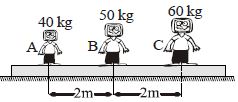
Three men $A, B$ and $C$ of masses $40\,\,kg, 50\,\,kg$ and $60\,\,kg$  are standing on a plank of mass $90\,\,kg,$  which is kept on a smooth horizontal plane. If $A$ and $C$ exchange their positions then mass $B$   will shift
A string in musical instrument is $50 cm$ long and its fundamental frequency is $800 Hz.$ If a frequency of $1000 Hz$ is to be produced, then required length of string is ..... $cm$
For a solenoid keeping the turn density constant its length is halved and its cross section radius is doubled then the inductance of the solenoid increased by.....$\%$
The molecules of a given mass of a gas have $r.m.s.$ velocity of $200 \,m s^{-1}$ at $27^o C$ and $1.0 \times 10^5 \,Nm^{-2}$ pressure. When the temperature and pressure of the gas are respectively, $127^o C$ and $0.05 \times 10^5 \,Nm^{-2},$ the $r.m.s.$ velocity of its molecules in $m s^{-1}$ is 
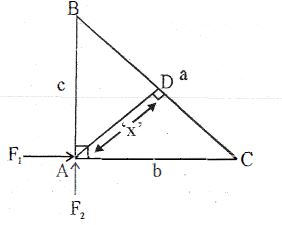
Two forces acting on point $A$ along their side and having magnitude reciprocal to length of side then resultant of these forces will be proportional to
A sphere of diameter $7\,\, cm$ and mass $266.5 \,\,gm$ floats in a bath of a liquid. As the temperature is raised, the sphere just begins to sink at a temperature $35^o C$. If the density of a liquid at $0^o C$ is $1.527 \,\,gm/cc$, then neglecting the expansion of the sphere, the coefficient of cubical expansion of the liquid is$f$ :
As a wave propagates
$Assertion :$ The buoyant force on a submerged rigid object can be considered to be acting at the centre of mass of the object.
$Reason :$ For a rigid body a force field distributed uniformly through its volume can be considered to be acting at the centre of mass of the body.