An inverted tube barometer is kept on a lift with a moving downward with a deceleration $\alpha $ . The density of mercury is $\rho$ and acceleration due to gravity is $g$ . If the atmospheric pressure be $P_0$ then
Medium


Download our appand get started for free
Experience the future of education. Simply download our apps or reach out to us for more information. Let's shape the future of learning together!No signup needed.*
Similar Questions
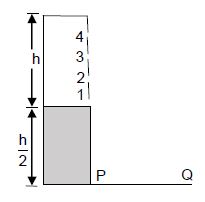
- 1A cylinder of height $h$ is filled with water and is kept on a block of height $h / 2$ . The level of water in the cylinder is kept constant. Four holes numbered $1, 2, 3$ and $4$ are at the side of the cylinder and at heights $0,\ h / 4,\ h / 2$ and $3h / 4$ respectively. When all four holes are opened together, the hole from which water will reach farthest distance on the plane $PQ$ is the hole numberView Solution
- 2What will be the nature of flow of water from a circular tap, when its flow rate increased from $0.18\, L / min$ to $0.48\, L / min$ ? The radius of the tap and viscosity of water are $0.5\, cm$ and $10^{-3}\, Pa s$, respectively.View Solution
(Density of water : $10^{3}\, kg / m ^{3}$ )
- 3Radius of an air bubble at the bottom of the lake is $r$ and it becomes $ 2r $ when the air bubbles rises to the top surface of the lake. If $P $ $cm$ of water be the atmospheric pressure, then the depth of the lake isView Solution
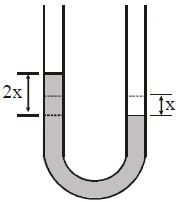
- 4$9\ kg$ of mercury is poured into a glass $U-tube$ with inner diameter of $1.2 \ cm$. The mercury can flow without friction within the tube. the oscillation period ......... $\sec$. Density of mercury = $13.6 × 10^3\ kg/m^3$.View Solution
- 5An air bubble of volume $1\,cm ^3$ rises from the bottom of a lake $40\,m$ deep to the surface at a temperature of $12^{\circ}\,C$. The atmospheric pressure is $1 \times 10^5 Pa$, the density of water is $1000\,kg / m ^3$ and $g =10\,m / s ^2$. There is no difference of the temperature of water at the depth of $40\,m$ and on the surface. The volume of air bubble when it reaches the surface will be $..........\,cm^{3}$View Solution
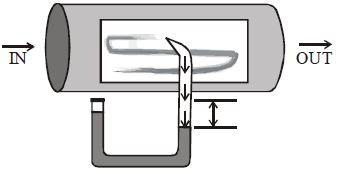
- 6The Pitot tube shown in the figure is used to measure fluid flow velocity in a pipe of cross sectional area $S$. It was invented by a French engineer Henri Pitot in the early $18^{th}$ century. The volume of the gas flowing across the section of the pipe per unit time is (The difference in the liquid columns is $\Delta h, \rho_0$ and $\rho$ are the densities of liquid and the gas respectively) :-View Solution
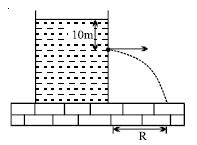
- 7A large tank is filled with water (density $=$ $10^3 $ $kg/m^3$).A small hole is made at a depth $10$ $m$ below water surface. The range of water issuing out of the hole is Ron ground. What extra pressure must be applied on the water surface so that the range becomes $2R $ (take $1$ $atm$ $=$ $10^5$ $Pa$ and $g$ $=$ $10$ $m/s^2):$ ...... $atm$View Solution
- 8An object is located at $2\, km$ beneath the surface of the water. If the fractional compression $\frac{\Delta V }{ V }$ is $1.36\, \%,$ the ratio of hydraulic stress to the corresponding hydraulic strain will be ......... . [Given : density of water is $1000\, kg m ^{-3}$ and $\left. g =9.8 \,ms ^{-2} .\right]$View Solution
- 9The density $\rho $ of water of bulk modulus $B $ at a depth y in the ocean is related to the density at surface ${\rho _0}$ by the relationView Solution
- 10At shallow depth $h$, the pressure in the ocean is simply given by $P = P_0 + \rho gh$, in which $\rho$ is the density of water and $P_0$ is the air pressure. As we go deeper, the high pressure causes the water to compress and become denser. Which of the following sketches illustrates the correct dependence of the pressure on the depth $h$ ?View Solution