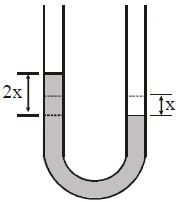
$9\ kg$ of mercury is poured into a glass $U-tube$ with inner diameter of $1.2 \ cm$. The mercury can flow without friction within the tube. the oscillation period ......... $\sec$. Density of mercury = $13.6 × 10^3\ kg/m^3$.
Diffcult


Download our appand get started for free
Experience the future of education. Simply download our apps or reach out to us for more information. Let's shape the future of learning together!No signup needed.*
Similar Questions
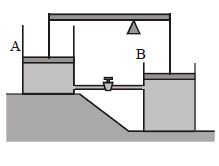
- 1In the arrangement shown both the vessels $A$ and $B$ are identical but amount of water in $B$ is double of that in $A$. The vessels are closed by identical leak proof pistons at the same height. The pistons are connected to the ends of lever arm. There is no friction between the pistons and the container walls. The system is in equilibrium in the situation shown. Now the valve in the horizontal tube connecting both the vessels is opened. In which direction will the water flow through the tube ?View Solution
- 2The area of cross-section of a large tank is $0.5 \; m ^{2}$. It has a narrow opening near the bottom having area of cross-section $1 \; cm ^{2}$. A load of $25 \; kg$ is applied on the water at the top in the tank. Neglecting the speed of water in the tank, the velocity of the water, coming out of the opening at the time when the height of water level in the tank is $40 \; cm$ above the bottom, will be $\dots \; cms ^{-1}$. $\left[\right.$ Take $\left.g =10 \; ms ^{-2}\right]$View Solution
- 3View SolutionIn Poiseuilli's method of determination of coefficient of viscosity, the physical quantity that requires greater accuracy in measurement is
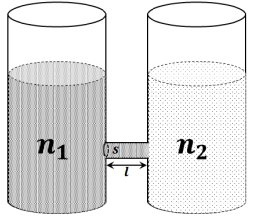
- 4As shown schematically in the figure, two vessels contain water solutions (at temperature $T$ ) of potassium permanganate $\left( KMnO _4\right)$ of different concentrations $n_1$ and $n_2\left(n_1>n_2\right)$ molecules per unit volume with $\Delta n=\left(n_1-n_2\right) \ll n_1$. When they are connected by a tube of small length $\ell$ and cross-sectional area $S , KMnO _4$ starts to diffuse from the left to the right vessel through the tube. Consider the collection of molecules to behave as dilute ideal gases and the difference in their partial pressure in the two vessels causing the diffusion. The speed $v$ of the molecules is limited by the viscous force $-\beta v$ on each molecule, where $\beta$ is a constant. Neglecting all terms of the order $(\Delta n)^2$, which of the following is/are correct? ( $k_B$ is the Boltzmann constant)-View Solution
$(A)$ the force causing the molecules to move across the tube is $\Delta n k_B T S$
$(B)$ force balance implies $n_1 \beta v \ell=\Delta n k_B T$
$(C)$ total number of molecules going across the tube per sec is $\left(\frac{\Delta n}{\ell}\right)\left(\frac{k_B T}{\beta}\right) S$
$(D)$ rate of molecules getting transferred through the tube does not change with time
- 5Given below are two statements:View Solution
Statement $I :$ Pressure in a reservoir of water is same at all points at the same level of water.
Statement $II :$ The pressure applied to enclosed water is transmitted in all directions equally.
In the light of the above statements, choose the correct answer from the options given below:
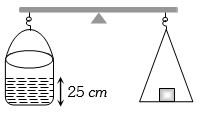
- 6A cylinder containing water up to a height of $25 cm$ has a hole of cross-section $\frac{1}{4}c{m^2}$ in its bottom. It is counterpoised in a balance. What is the initial change in the balancing weight when water begins to flow outView Solution
- 7Ajet of water having velocity $=$ $10 $ $m/s$ and stream cross-section $=$ $2$ $cm^2$ hits a flat plate perpendicularly, with the water splashing out parallel to plate. The plate experiences a force of ....... $N$View Solution
- 8Three liquids of equal masses are taken in three identical cubical vessels $A, B$ and $C .$ Their densities are $\rho_{A}, \rho_{B}$ and $\rho_{C} \cdot$ The force exerted by the liquid on the base of the cubical vessel isView Solution
- 9Water flows in a stream line manner through a capillary tube of radius $a$. The pressure difference being $P$ and the rate of flow is $Q$. If the radius is reduced to $\frac{a}{4}$ and the pressure is increased to $4 P$. then the rate of flow becomes ................View Solution
- 10Karman line is a theoretical construct that separates the earth's atmosphere from outer space. It is defined to be the height at which the lift on an aircraft flying at the speed of a polar satellite $(8 \,km / s )$ is equal to its weight. Taking a fighter aircraft of wing area $30 \,m ^2$, and mass $7500 \,kg$, the height of the Karman line above the ground will be in the range .............. $km$ (assume the density of air at height $h$ above ground to be $\rho( h )=1.2 e ^{\frac{ h }{10}} \,kg / m ^3$ where $h$ is in $km$ and the lift force to be $\frac{1}{2} \rho v^2 A$, where $v$ is the speed of the aircraft and $A$ its wing area).View Solution