An iron rod of length $2m$ and cross section area of $50\,m{m^2}$, stretched by $0.5\, mm$, when a mass of $250\, kg$ is hung from its lower end. Young's modulus of the iron rod is
Easy
Download our app for free and get started
(a) $Y = \frac{{MgL}}{{Al}} = \frac{{250 \times 9.8 \times 2}}{{50 \times {{10}^{ - 6}} \times 0.5 \times {{10}^{ - 3}}}}$
$ = 19.6 \times {10^{10}}N/{m^2}$

Download our appand get started for free
Experience the future of education. Simply download our apps or reach out to us for more information. Let's shape the future of learning together!No signup needed.*
Similar Questions
- 1Two wires $‘A’$ and $‘B’$ of the same material have radii in the ratio $2 : 1$ and lengths in the ratio $4 : 1$. The ratio of the normal forces required to produce the same change in the lengths of these two wires isView Solution
- 2A steel wire is $1 \,m$ long and $1 \,mm ^2$ in area of cross$-$section. If it takes $200 \,N$ to stretch this wire by $1 \,mm$, how much force will be required to stretch a wire of the same material as well as diameter from its normal length of $10 \,m$ to a length of $1002 \,cm$ is $........ N$View Solution
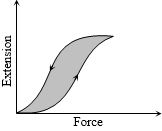
- 3The diagram shows a force-extension graph for a rubber band. Consider the following statementsView Solution
$I.$ It will be easier to compress this rubber than expand it
$II.$ Rubber does not return to its original length after it is stretched
$III.$ The rubber band will get heated if it is stretched and released
Which of these can be deduced from the graph
- 4Two wires $A$ and $B$ of same length, same area of cross-section having the same Young's modulus are heated to the same range of temperature. If the coefficient of linear expansion of $A$ is $3/2$ times of that of wire $B$. The ratio of the forces produced in two wires will beView Solution
- 5The pressure applied from all directions on a cube is $P$. How much its temperature should be raised to maintain the original volume $?$ The volume elasticity of the cube is $\beta $ and the coefficient of volume expansion is $\alpha $View Solution
- 6If the Bulk modulus of lead is $8.0 \times 10^9 \,N / m ^2$ and the initial density of the lead is $11.4 \,g / cc$, then under the pressure of $2.0 \times 10^8 \,N / m ^2$, the density of the lead is ............. $g / cc$View Solution
- 7View SolutionThe spring balance does not read properly after its long use, because
- 8What must be the lengths of steel and copper rods at $0^o C$ for the difference in their lengths to be $10\,cm$ at any common temperature? $(\alpha_{steel}=1.2 \times {10^{-5}} \;^o C^{-1})$ and $(\alpha_{copper} = 1.8 \times 10^{-5} \;^o C^{-1})$View Solution
- 9A wire elongates by $l$ $mm$ when a load $W$ is hanged from it. If the wire goes over a pulley and two weights $W$ each are hung at the two ends, the elongation of the wire will be (in $mm$)View Solution
- 10Consider a thin square plate floating on a viscous liquid in a large tank. The height $h$ of the liquid in the tank is much less than the width of the tank. The floating plate is pulled horizontally with a constant velocity $u_0$. Which of the following statements is (are) true?View Solution
$(A)$ The resistive force of liquid on the plate is inversely proportional to $h$
$(B)$ The resistive force of liquid on the plate is independent of the area of the plate
$(C)$ The tangential (shear) stress on the floor of the tank increases with $u _0$
$(D)$ The tangential (shear) stress on the plate varies linearly with the viscosity $\eta$ of the liquid