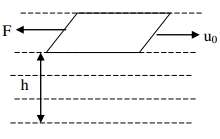
Consider a thin square plate floating on a viscous liquid in a large tank. The height $h$ of the liquid in the tank is much less than the width of the tank. The floating plate is pulled horizontally with a constant velocity $u_0$. Which of the following statements is (are) true?
$(A)$ The resistive force of liquid on the plate is inversely proportional to $h$
$(B)$ The resistive force of liquid on the plate is independent of the area of the plate
$(C)$ The tangential (shear) stress on the floor of the tank increases with $u _0$
$(D)$ The tangential (shear) stress on the plate varies linearly with the viscosity $\eta$ of the liquid
IIT 2018, Medium


Download our appand get started for free
Experience the future of education. Simply download our apps or reach out to us for more information. Let's shape the future of learning together!No signup needed.*
Similar Questions
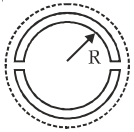
- 1A wooden wheel of radius $R$ is made of two semicircular part (see figure). The two parts are held together by a ring made of a metal strip of cross section area $S$ and length $L$. $L$ is slighly less than $2\pi R$. To fit the ring on the wheel, it is heated so that its temperature rises by $\Delta T$ and it just steps over the wheel.As it cools down to surronding temperature, it presses the semicircular parts together. If the coefficint of linear expansion of the metal is $\alpha$, and its young's modulus is $Y$, the force that one part of wheel applies on the other part isView Solution
- 2View SolutionIn the three states of matter, the elastic coefficient can be
- 3A structural steel rod has a radius of $10\,mm$ and length of $1.0\,m.$ A $100\,kN$ force stretches it along its length . Young's modulus of structural steel is $2 \times 10^{11}\,Nm^{-2}.$ The percentage strain is about ....... $\%$View Solution
- 4Given below are two statements: one is labelled as Assertion$(A)$ and the other is labelled as Reason $(R).$View Solution
$Assertion$ $(A)$ : In Vernier calliper if positive zero error exists, then while taking measurements, the reading taken will be more than the actual reading.
$Reason$ $(R)$ : The zero error in Vernier Calliper might have happened due to manufacturing defect or due to rough handling.
In the light of the above statements, choose the correct answer from the options given below :
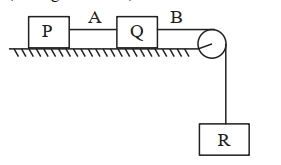
- 5Each of three blocks $P$, $Q$ and $R$ shown in figure has a mass of $3 \mathrm{~kg}$. Each of the wire $A$ and $B$ has cross-sectional area $0.005 \mathrm{~cm}^2$ and Young's modulus $2 \times 10^{11} \mathrm{~N} \mathrm{~m}^{-2}$. Neglecting friction, the longitudinal strain on wire $B$ is____________ $\times 10^{-4}$. $\left(\right.$ Take $\mathrm{g}=10 \mathrm{~m} / \mathrm{s}^2$ )View Solution
- 6View SolutionWhich of the following is true for elastic potential energy density
- 7Choose the correct relationship between Poisson ratio $(\sigma)$. bulk modulus $( K )$ and modulus of rigidity $(\eta)$ of a given solid object:View Solution
- 8A wire of length $L$ and radius $r$ is clamped rigidly at one end. When the other end of the wire is pulled by a force $F$, its length increases by $5\,cm$. Another wire of the same material of length $4 L$ and radius $4\,r$ is pulled by a force $4\,F$ under same conditions. The increase in length of this wire is $....cm$.View Solution
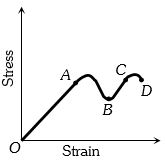
- 9In the below graph, point $D$ indicatesView Solution
- 10A force of ${10^3}$ newton stretches the length of a hanging wire by $1$ millimetre. The force required to stretch a wire of same material and length but having four times the diameter by $1$ millimetre isView Solution