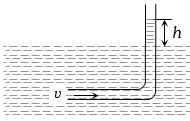
An $ L-$ shaped glass tube is just immersed in flowing water such that its opening is pointing against flowing water. If the speed of water current is $v$, then
Easy
Download our app for free and get started
(a) Here final velocity of water at the top of tube is zero after gaining a height.
At the lowest point in the tube height is taken zero.
From Bernoulli equation$:$
$P+0+\frac{1}{2} \rho v^{2}=P+\rho g h+0$
$\frac{1}{2} \rho v^{2}=\rho g h$
$h=\frac{v^{2}}{2 g}$
Thus, the final height attained by liquid in the tube is $\frac{v^{2}}{2 g}$

Download our appand get started for free
Experience the future of education. Simply download our apps or reach out to us for more information. Let's shape the future of learning together!No signup needed.*
Similar Questions
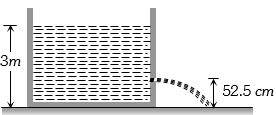
- 1Water is filled in a cylindrical container to a height of $3m. $ The ratio of the cross-sectional area of the orifice and the beaker is $ 0.1. $ The square of the speed of the liquid coming out from the orifice is ....... $m^2/s^2$ ($g = 10 m/s^2$)View Solution
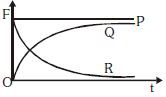
- 2A heavy spherical ball is dropped near surface in a long column of viscous liquid. Which of the following graphs represent the variation ofView Solution
$(i)$ Gravitational force with time
$(ii)$ Viscous force with time
$(iii)$ Net force acting on the ball with time
- 3Water is flowing continuously from a tap having an internal diameter $8 \times 10^{-3}\ m $ The water velocity as it leaves the tap is $0.4$ $ms^{-1}$ છે. The diameter of the water stream at a distance $2 \times 10^{-1}$ $m$ below the tap is close to .......$\times 10^{-3}\;m$View Solution
- 4View SolutionA small steel ball is dropped into a long cylinder containing glycerine. Which one of the following is the correct representation of the velocity time graph for the transit of the ball?
- 5A spherical ball of radius $1 \times 10^{-4} \mathrm{~m}$ and density $10^5$ $\mathrm{kg} / \mathrm{m}^3$ falls freely under gravity through a distance $h$ before entering a tank of water, If after entering in water the velocity of the ball does not change, then the value of $h$ is approximately:View Solution
(The coefficient of viscosity of water is $9.8 \times 10^{-6}$ $\left.\mathrm{N} \mathrm{s} / \mathrm{m}^2\right)$
- 6Two liquids of densities $d_1$ and $d_2$ are flowing in identical capillary tubes uder the same pressure difference. Ift $t_1$ and $t_2$ are time taken for the flow of equal quantities (mass) of liquids, then the ratio of coefficient of viscosity of liquids must beView Solution
- 7A cubical block of side $‘a’$ and density $‘\rho ’$ slides over a fixed inclined plane with constant velocity $‘v’$. There is a thin film of viscous fluid of thickness $‘t’$ between the plane and the block. Then the coefficient of viscosity of the thin film will be:View Solution
- 8A train with cross-sectional area $S _{ t }$ is moving with speed $v_t$ inside a long tunnel of cross-sectional area $S _0\left( S _0=4 S _{ t }\right)$. Assume that almost all the air (density $\rho$ ) in front of the train flows back between its sides and the walls of the tunnel. Also, the air flow with respect to the train is steady and laminar. Take the ambient pressure and that inside the train to be $p _0$. If the pressure in the region between the sides of the train and the tunnel walls is $p$, then $p _0- p =\frac{7}{2 N } \rho v_{ t }^2$. The value of $N$ is. . . . .View Solution
- 9In Millikan's oil drop experiment, what is viscous force acting on an uncharged drop of radius $2.0 \times 10^{-5}\, {m}$ and density $1.2 \times 10^{3} \,{kgm}^{-3}$ ? Take viscosity of liquid $=1.8 \times 10^{-5}\, {Nsm}^{-2} .$ (Neglect buoyancy due to air).View Solution
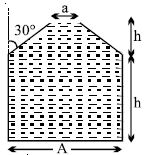
- 10The vessel shown in the figure has two sections. The lower part is a rectangular vessel with area of cross-section $A$ and height $h$. The upper part is a conical vessel of height $h$ with base area $‘A’$ and top area $‘a’$ and the walls of the vessel are inclined at an angle $30^o$ with the vertical.A liquid of density $\rho$ fills both the sections upto a height $2h$. Neglecting atmospheric pressure.View Solution