In Millikan's oil drop experiment, what is viscous force acting on an uncharged drop of radius $2.0 \times 10^{-5}\, {m}$ and density $1.2 \times 10^{3} \,{kgm}^{-3}$ ? Take viscosity of liquid $=1.8 \times 10^{-5}\, {Nsm}^{-2} .$ (Neglect buoyancy due to air).
JEE MAIN 2021, Medium
Download our app for free and get started
Viscous force $=$ Weight
$=\rho \times\left(\frac{4}{3} \pi^{3}\right) \,g$
$=3.9 \times 10^{-10}$

Download our appand get started for free
Experience the future of education. Simply download our apps or reach out to us for more information. Let's shape the future of learning together!No signup needed.*
Similar Questions
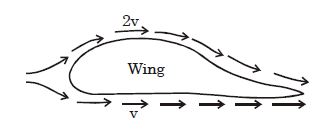
- 1The flow speeds of air on the lower and upper surfaces of the wing of an aeroplane are $v$ and $2v$ respectively. The density of air is $\rho $ and surface area of wing is $A$ . The dynamic lift on the wing isView Solution
- 2Three liquids of densities $d,\,2d$ and $3d$ are mixed in equal volumes. Then the density of the mixture isView Solution
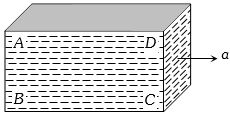
- 3A closed rectangular tank is completely filled with water and is accelerated horizontally with an acceleration a towards right. Pressure is $(i)$ maximum at, and $ (ii) $ minimum atView Solution
- 4Two immiscible liquids $A$ and $B$ are kept in an U-tube. If the density of liquid $A$ is smaller than the density of liquid $B$, then the equilibrium situation isView Solution
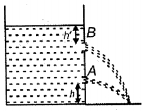
- 5A tank is filled with water and two holes $A$ and $B$ are made in it. For getting same range, ratio of $h^{\prime} T h$ is ..........View Solution
- 6Three liquids of densities $d,\,2d$ and $3d$ are mixed in equal proportions of weights. The relative density of the mixture isView Solution
- 7A ball whose density is $0.4 \times 10^3\,kg/m^3$ falls into water from a height of $9\,cm$ . To what depth does the ball sink ? ....... $cm$View Solution
- 8Two liquids of densities $d_1$ and $d_2$ are flowing in identical capillary tubes uder the same pressure difference. Ift $t_1$ and $t_2$ are time taken for the flow of equal quantities (mass) of liquids, then the ratio of coefficient of viscosity of liquids must beView Solution
- 9Some liquid is filled in a cylindrical vessel of radius $R$. Let $ F_1 $ be the force applied by the liquid on the bottom of the cylinder. Now the same liquid is poured into a vessel of uniform square crss-section of side $R$. Let $F_2$ be the force applied by the liquid on the bottom of this new vessel. Then:View Solution
- 10$Assertion :$ The velocity of flow of a liquid is smaller when pressure is larger and vice-versa.View Solution
$Reason :$ According to Bernoulli’s theorem, for the stream line flow of an ideal liquid, the total energy per unit mass remains constant.