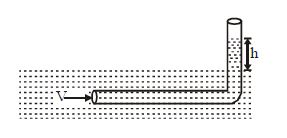
An $L-$ shaped glass tube is just immersed in flowing water towards tube as shown. If speed of water current is $V,$ then the height $h$ upto which water rises will be
Medium
Download our app for free and get started
$\mathrm{P}_{1}+\rho \mathrm{gh}_{1}+\frac{1}{2} \rho \mathrm{V}_{1}^{2}=\mathrm{P}_{2}+\rho \mathrm{gh}_{2}+\frac{1}{2} \rho \mathrm{V}_{2}^{2}$
$\Rightarrow \frac{1}{2} \rho V_{1}^{2}=\rho g h_{2}+0 \quad\left(V_{2}=0\right) \Rightarrow h_{2}=\frac{V^{2}}{2 g}$
$O R$
$KE$ per unit volume $=$ $P.E$ per unit volume $\Rightarrow \frac{1}{2} \rho \mathrm{V}^{2}=\rho \mathrm{gh} \quad \Rightarrow \quad \mathrm{h}=\frac{\mathrm{V}^{2}}{2 \mathrm{g}}$

Download our appand get started for free
Experience the future of education. Simply download our apps or reach out to us for more information. Let's shape the future of learning together!No signup needed.*
Similar Questions
- 1A concrete sphere of radius $R$ has a cavity of radius $ r$ which is packed with sawdust. The specific gravities of concrete and sawdust are respectively $2.4$ and $0.3$ for this sphere to float with its entire volume submerged under water. Ratio of mass of concrete to mass of sawdust will beView Solution
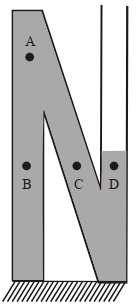
- 2Consider a mercury-filled tube as shown in the figure belowView Solution
Which of the following options about the pressures at the lettered locations $(A, B, C, D)$ is true?
- 3Air is streaming past a horizontal air plane wing such that its speed in $ 120 m/s$ over the upper surface and $ 90 m/s$ at the lower surface. If the density of air is $1.3 kg$ per $metre^3 $ and the wing is $10 m $ long and has an average width of $2 m$, then the difference of the pressure on the two sides of the wing of ....... $Pascal$View Solution
- 4A cylindrical vessel of cross-section $A$ contains water to a height $h$ . There is a hole in the bottom of radius $'a'$ . The time in which it will be emptied isView Solution
- 5Two uniform solid balls of same density and of radii $r$ and $2r$ are dropped in air and fall vertically downwards. The terminal velocity of the ball with radius $r$ is $1\,cm\,s^{-1}$ , then find the terminal velocity of the ball of radius $2r$ (neglect bouyant force on the balls.) ........... $cm\,s^{-1}$View Solution
- 6The Bhagirathi and the Alaknanda merge at Deoprayag to form the Ganga with their speeds in the ratio $1: 1: 5$. The cross-sectional areas of the Bhagirathi, the Alaknanda and the Ganga are in the ratio $1: 2: 3$. Assuming streamline flow, the ratio of the speed of Ganga to that of the Alaknanda isView Solution
- 7For the situation shown in the figure, water flows on the surface of a fixed plate. TheView Solution
velocity of water as a function of distance $'y'$ is given as : $u = \alpha \left[ {\frac{y}{h} - 2{{\left( {\frac{y}{h}} \right)}^2}} \right]$ . Determine the magnitude of the shear stress that the water applies at the base of the plate. Coefficient of viscosity is $\eta$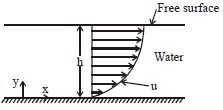
- 8A machine is blowing spherical soap bubbles of different radii filled with helium gas.It is found that, if the bubbles have a radius smaller than $1\,cm$, then they sink to the floor in still air. Larger bubbles float in the air. Assume that the thickness of the soap film in all bubbles is uniform and equal. Assume that the density of soap solution is same as that of water $\left(=1000 \,kg m ^{-3}\right)$. The density of helium inside the bubbles and air are $0.18 \,kg m ^{-3}$ and $1.23 \,kg m ^{-3}$, respectively. Then, the thickness of the soap film of the bubbles is .......... $\mu m$ (Note $1 \,\mu m =10^{-6} \,m$ )View Solution
- 9The velocity of upper layer of water in a river is $36 kmh ^{-1}$. Shearing stress between horizontal layers of water is $10^{-3} Nm ^{-2}$. Depth of the river is $m$. (Co-efficiency of viscosity of water is $10^{-2} \,Pa . s$ )View Solution
- 10The terminal velocity of a copper ball of radius $5\,mm$ falling through a tank of oil at room temperature is $10\,cm\,s ^{-1}$. If the viscosity of oil at room temperature is $0.9\,kg\,m ^{-1} s ^{-1}$, the viscous drag force is :View Solution