MCQ
An $LED$ (Light Emitting Diode) is constructed from a $p-n$ junction based on a certain $Ga-As-P$ semi-conducting material whose energy gap is $1.9\, eV$. What is the wavelength of the emitted light?
  • $650\, nm$
  • B
    $65\,\mathop A\limits^o $
  • C
    $800\, nm$
  • D
    $8000\,\mathop A\limits^o $

Answer

Correct option: A.
$650\, nm$
a
The wavelength of emitted light

$\lambda=\frac{h c}{E_{g}}$

where $\mathrm{E}_{\mathrm{g}}=$ energy gap of semiconductor

$=1.9\, \mathrm{eV}$

$=1.9 \times 1.6 \times 10^{-19} \,\mathrm{V}$

$\lambda=\frac{6.6 \times 10^{-34} \times 3 \times 10^{8}}{1.9 \times 1.6 \times 10^{-19}} \,\mathrm{m}$

$=6.5 \times 10^{-7}\, \mathrm{m}$

$=650 \times 10^{-9}\, \mathrm{m}$

$=650 \,\mathrm{nm}$

Need a full question paper?

Generate a complete, print-ready paper with questions like this in minutes — across 16+ boards, with answer keys.

Start Generating Free

Similar questions

When a beam of light is used to determine the position of an object, the maximum accuracy is achieved if the light is
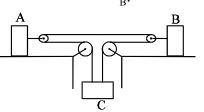
If acceleration of $A$ is $2 \,\,m/s^2$ to left and acceleration of $B$ is $1\,\,m/s^2$ to left, then acceleration of $C$ is
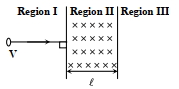
A particle of mass $m$ and charge $\mathrm{q}$, moving with velocity $\mathrm{V}$ enters Region $II$ normal to the boundary as shown in the figure. Region $II$ has a uniform magnetic field B perpendicular to the plane of the paper. The length of the Region $II$ is $\ell$. Choose the correct choice$(s)$.

Figure: $Image$

$(A)$ The particle enters Region $III$ only if its velocity $V>\frac{q / B}{m}$

$(B)$ The particle enters Region $III$ only if its velocity $\mathrm{V}<\frac{\mathrm{q} / \mathrm{B}}{\mathrm{m}}$

$(C)$ Path length of the particle in Region $II$ is maximum when velocity $V=\frac{q / B}{m}$

$(D)$ Time spent in Region $II$ is same for any velocity $V$ as long as the particle returns to Region $I$

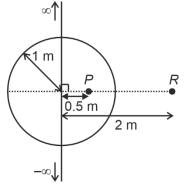
An infinitely long thin wire, having a uniform charge density per unit length of $5 nC / m$, is passing through a spherical shell of radius $1 m$, as shown in the figure. A $10 nC$ charge is distributed uniformly over the spherical shell. If the configuration of the charges remains static, the magnitude of the potential difference between points $P$ and $R$, in Volt, is. . . .

[Given: In SI units $\frac{1}{4 \pi \in_0}=9 \times 10^9, \ln 2=0.7$. Ignore the area pierced by the wire.]

The mass of the moon is $(1/8)$ of the earth but the gravitational pull is $(1/6)$ of the earth. It is due to the fact that.
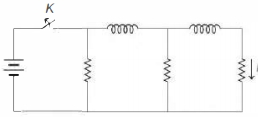
In the circuit shown below, all the inductors (assumed ideal) and resistors are identical. The current through the resistance on the right is $I$ after the key $K$ has been switched $ON$ for a long time. The currents through the three resistors (in order, from left to right) immediately after the key is switched OFF are
A curved in a level road has a radius $75\, m$. The maximum speed of a car turning this curved road can be $30 \,m / s$ without skidding. If radius of curved road is changed to $48\, m$ and the coefficient of friction between the tyres and the road remains same, then maximum allowed speed would be .........$m / s$.
A $2\, kg$ stone at the end of a string $1 \,m$ long is whirled in a vertical circle at a constant speed. The speed of the stone is $4 \,m/sec$. The tension in the string will be $52\, N$, when the stone is
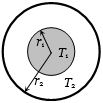
The figure shows a system of two concentric spheres of radii $r_1$ and $r_2$ and kept at temperatures $T_1$ and $T_2$, respectively. The radial rate of flow of heat in a substance between the two concentric spheres is proportional to
Voltmeter reads potential difference across the terminals of an old battery as $1.2\,volt$ , while a potentiometer reads $1.4\,volt$ . The internal resistance of battery is $40\,\Omega $ , then voltmeter resistance is .............. $\Omega$