Question
An LR circuit has L = 1.0H and $\text{R}=20\Omega.$ It is connected across an emf of 2.0V at t = 0. Find $\frac{\text{di}}{\text{dt}}$ at:
  1. t = 100ms
  2. t = 200ms
  3. t = 1.0s

Answer

$\text{L}=1.0 \text{H}, \ \text{R}=20 \Omega, \ \text{emf}=2.0\text{V }$$\tau=\frac{\text{L}}{\text{R}}=\frac{1}{20}=0.05 $
$\text{i}_0=\frac{\text{e}}{\text{R}}=\frac{2}{20}=0.1\text{A} $
$\text{i}=\text{i}_0(1-\text{e}^{-\text{t}})=\text{i}_0-\text{i}_0\text{e}^{-\text{t}} $
$\Rightarrow\frac{\text{di}}{\text{dt}}=\frac{\text{di}_0}{\text{dt}}\Big(\text{i}_0\times-\frac{1}{\tau}\times\text{e}^\frac{-\text{t}}{\tau}\Big)=\frac{\text{i}_0}{\tau}\text{e}^\frac{-\text{e}}{\tau }$
So,
  1. $\text{t}=100\text{ms}\Rightarrow\frac{\text{di}}{\text{dt}}=\frac{0.1}{0.05}\times\text{e}^\frac{-0.1}{0.0.05}=0.27 \text{A}$
  2. $\text{t}=200\text{ms}\Rightarrow\frac{\text{di}}{\text{dt}}=\frac{0.1}{0.05}\times\text{e}^\frac{-0.2}{0.05}=0.0366 \text{A }$
  3. $\text{t}=1\text{s}\Rightarrow\frac{\text{di}}{\text{dt}}=\frac{0.1}{0.05}\times\text{e}^\frac{-1}{0.05}=4\times10^{-9}\text{A }$

Need a full question paper?

Generate a complete, print-ready paper with questions like this in minutes — across 16+ boards, with answer keys.
Start Generating Free

Similar questions

Calculate the number of degrees of freedom of molecules of hydrogen in $1cc$ of hydrogen gas at NTP.
A SHM is expressed by the equation $\text{x}=\text{A}\cos(\omega\text{t}+\phi)$ and the phase angle $\phi=0$ . Draw graphs to show variation of displacement, velocity and acceleration for one complete cycle in SHM.
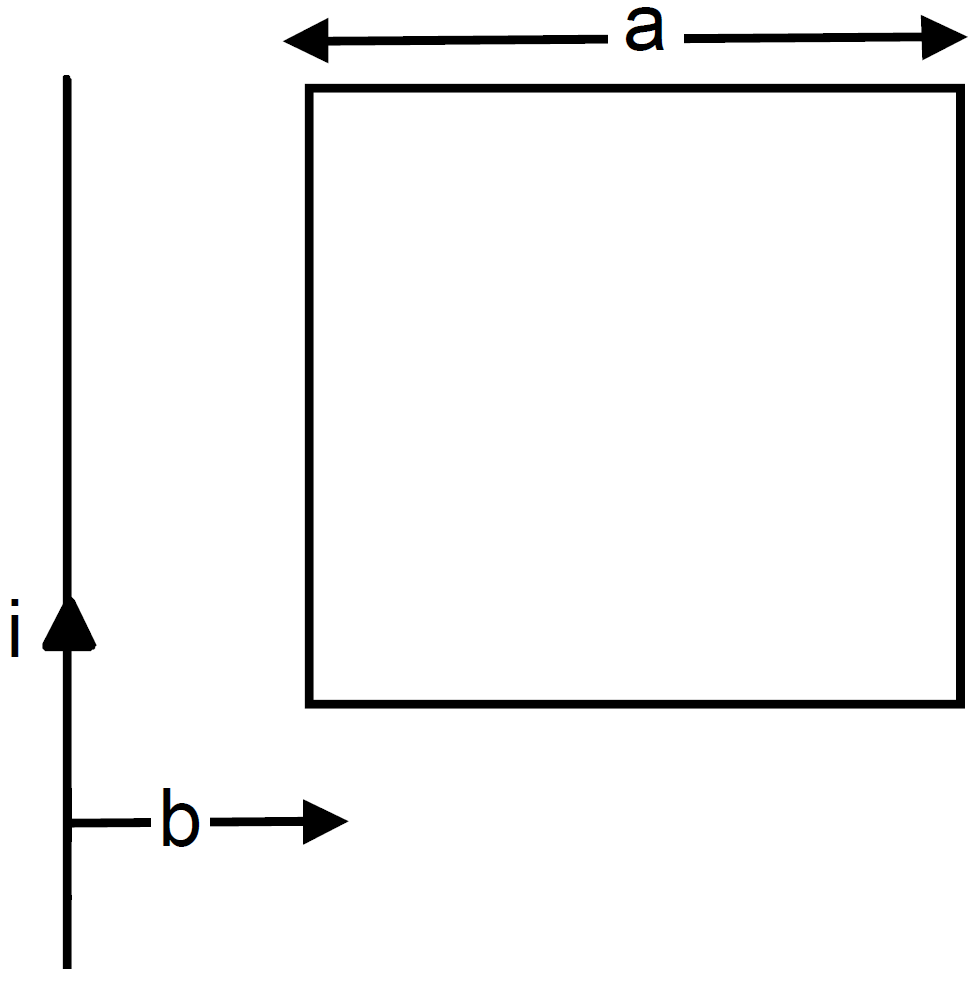
Find the mutual inductance between the straight wire and the square loop of figure.
A particle of mass 0.8kg is executing simple harmonic motion with amplitude of 1.0 metre and periodic time $\frac{11}{7}\text{sec}$. Calculate the velocity and the kinetic energy of the particle at the moment when its displacement is 0.6 metre.
What are the rules for rounding off a number? Explain each rule with examples.
An air bubble of radius $2.0mm$ is formed at the bottom of a $3.3m$ deep river. Calculate the radius of the bubble as it comes to the surface. Atmospheric pressure = $1.0 \times 10^5 Pa$ and density of water = $1000kg/m^{-3}$.
A vector has both magnitude and direction. Does it mean that anything that has magnitude and direction is necessarily a vector? The rotation of a body can be specified by the direction of the axis of rotation, and the angle of rotation about the axis. Does that make any rotation a vector?
  1. Define critical velocity of liquid flow and state the factors affecting the critical velocity of liquid.
  2. Define terminal velocity. Establish an expression for it for a spherical body falling through a viscous medium.
A torsional pendulum consists of a solid disc connected to a thin wire$\Big(\alpha=2.4\times10^{-5}\ ^\circ\text{C}^{-1}\Big)$at its centre. Find the percentage change in the time period between peak winter $(5^\circ C)$ and peak summer $(45^\circ C)$.
A satellite is in an elliptic orbit around the earth with aphelion of $6R$ and perihelion of 2R where $R = 6400km$ is the radius of the earth. Find eccentricity of the orbit. Find the velocity of the satellite at apogee and perigee. What should be done if this satellite has to be transferred to a circular orbit of radius $6R$?[$G = 6.67 \times 10^{–11}$ SI units and $4M = 6 \times 10^{24}kg$]