Question
What are the rules for rounding off a number? Explain each rule with examples.

Answer

self

Need a full question paper?

Generate a complete, print-ready paper with questions like this in minutes — across 16+ boards, with answer keys.
Start Generating Free

Similar questions

A stone is thrown vertically upward with a speed of $28m/s$.
  1. Find the maximum height reached by the stone.
  2. Find its velocity one second before it reaches the maximum height.
  3. Does the answer of part.
  4. Change if the initial speed is more than $28m/s$ suchas $40m/s$ or $80m/s$?
A trolley of mass $200kg$ moves with a uniform speed of $36km/h$ on a frictionless track. A child of mass $20kg$ runs on the trolley from one end to the other ($10m$ away) with a speed of $4ms^{-1}$ relative to the trolley in a direction opposite to the its motion, and jumps out of the trolley. What is the final speed of the trolley? How much has the trolley moved from the time the child begins to run?
A perfectly elastic rubber ball is dropped from the top of a building. A man standing in front of a window $2m$ high notes that the ball takes a time of $0.2s$ in crossing the window. The ball strikes the ground suffering a perfectly elastic collision and reappears at the bottom of the window during its upward journey again after $2$ seconds. What is (1) the height of the building and (2) the height of the bottom of the window above the ground? Take $g = 10ms^{-2}$.
State and prove Bernoulli's theorem.
  1. An electron moves along a circle of radius 1m in a perpendicular magnetic field of strength 0.50T. What would be its speed? Is it reasonable?
  2. If a proton moves along a circle of the same radius in the same magnetic field, what would be its speed?
What are progressive waves? Explain their construction write their main characteristics.
What is meant by resolution of a vector? Prove that a vector can be resolved along two given directions in one and only one way.
A parallel-plate capacitor having plate area $20cm^2$ and separation between the plates 1.00mm is connected to a battery of 12.0V. The plates are pulled apart to increase the separation to 2.0mm.
  1. Calculate the charge flown through the circuit during the process.
  2. How much energy is absorbed by the battery during the process?
  3. Calculate the stored energy in the electric field before and after the process.
  4. Using the expression for the force between the plates, find the work done by the person pulling the plates apart.
  5. Show and justify that no heat is produced during this transfer of charge as the separation is increased.
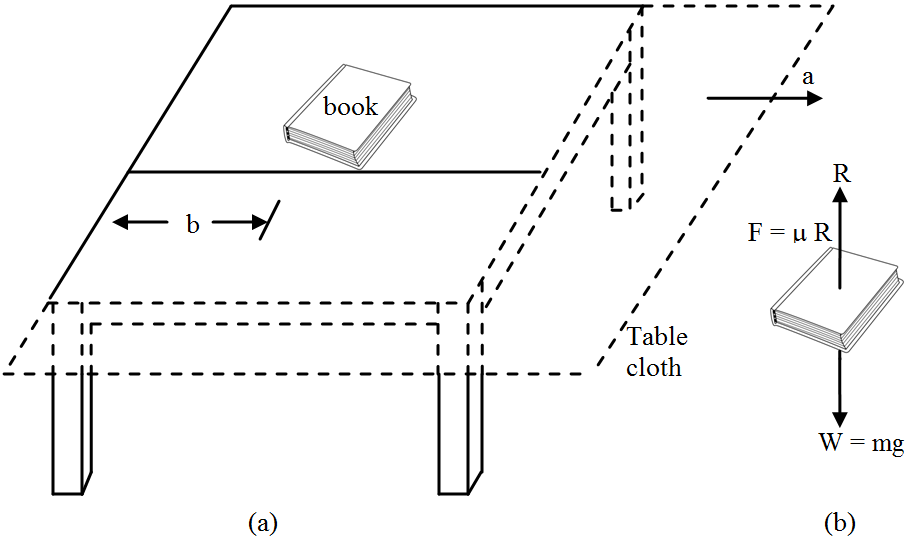
A book rests on a table cloth spread over a table as shown in Fig. The centre of the book is at a distance of b from the edge of the table at time t = 0; the table cloth is suddenly pulled at this instant with an acceleration a. Show that the cloth will slip from under the book if a > µ g, where u is the coefficient of sliding friction between the table cloth and the book. Assuming this condition to be satisfied. calculate:
  1. Time instant.
  2. The velocity.
  3. The distance of the centre of the book from the edge of the table when the edge of the table cloth passes over the centre of the book.
A tightly-wound, long solenoid is kept with its axis parallel to a large metal sheet carrying a surface current. The surface current through a width dl of the sheet is Kdl and the number of turns per unit length of the solenoid is n. The magnetic field near the centre of the solenoid is found to be zero.
  1. Find the current in the solenoid.
  2. If the solenoid is rotated to make its axis perpendicular to the metal sheet, what would be the magnitude of the magnetic field near its centre ?