Question
An object falling through a fluid is observed to have acceleration given by a = g - bv where g = gravitational acceleration and b is constant. After a long time of release, it is observed to fall with constant speed. What must be the value of constant speed?

Answer

Key concept: If a spherical body of radius r is dropped in a viscous fluid, it is first accelerated and then its acceleration becomes zero and it attains a constant velocity called terminal velocity.
According to the problem, acceleration of object is given by the relation
a = g - bv
When speed becomes constant acceleration $\text{a}=\frac{\text{dv}}{\text{dt}}=0$ (uniform motion).
where, g = gravitational acceleration
Clearly, from above equation as speed increases acceleration will decrease. At a certain speed say v0, acceleration will be zero and speed will remain constant.
Hence, $\text{a}=\text{g}-\text{bv}_0=0$
$\Rightarrow\text{v}_0=\frac{\text{g}}{\text{b}}$

Need a full question paper?

Generate a complete, print-ready paper with questions like this in minutes — across 16+ boards, with answer keys.

Start Generating Free

Similar questions

A rubber string 10m long is suspended from a rigid support at its one end. Calculate the extension in the string due to its own weight. The density of rubber is 1.5 × 10³kg/ m and Young's modulus for the rubber is 5 × 100N/ m2.
The breaking stress for a metal is 7.8 × 10⁹N/ m2. Calculate the maximum length of the wire made of this metal with may be suspended without breaking. The density of metal = 7.8 × 10³kg/ m3.
A person trying to lose weight (dieter) lifts a 10kg mass, one thousand times, to a height of 0.5m each time. Assume that the potential energy lost each time she lowers the mass is dissipated.
  1. How much work does she do against the gravitational force?
  2. Fat supplies 3.8 × 10⁷J of energy per kilogram which is converted to mechanical energy with a 20% efficiency rate. How much fat will the dieter use up?
Suppose the rod with the balls A and B of the previous problem is clamped at the centre in such a way that it can rotate freely about a horizontal axis through the clamp. The system is kept at rest in the horizontal position. A particle P of the same mass m is dropped from a height h on the ball B. The particle collides with B and sticks to it:
  1. Find the angular momentum and the angular speed of the system just after the collision.
  2. What should be the minimum value of h so that the system makes a full rotation after the collision.
A wave propagates on a string in the positive x-direction at a velocity v. The shape of the string at t = to is given by $\text{g}(\text{x},\text{t}_0)=\text{A}\sin\big(\frac{\text{x}}{\text{a}}\big).$ Write the wave equation for a general time t.
A child running a temperature of 101°F is given an antipyrin (i.e. a medicine that lowers fever) which causes an increase in the rate of evaporation of sweat from his body. If the fever is brought down to 98°F in 20 minutes, what is the average rate of extra evaporation caused, by the drug. Assume the evaporation mechanism to be the only way by which heat is lost. The mass of the child is 30kg. The specific heat of human body is approximately the same as that of water, and latent heat of evaporation of water at that temperature is about 580cal g–1.
A quarterback, standing on his opponents 35-yard line, throws a football directly down field, releasing the ball at a height of 2.00m above the ground with an initial velocity of 20.0m/ s, directed 30.0° above the horizontal.
  1. How long does it take for the ball to cross the goal line, 32.0m from the point of release?
  2. The ball is thrown too hard and so passes over the head of the intended receiver at the goal line. What is the ball's height above the ground as it crosses the goal line?
Solve the previous problem if the pulley has a moment of inertia I about its axis and the string does not slip over it.
Two particles of mass 2kg and 1kg are moving along the same line with speeds 2ms-1 and 5ms-1 respectively. What is the speed of the centre of mass of the system if both the particles are moving (a) in same direction (b) in opposite direction?
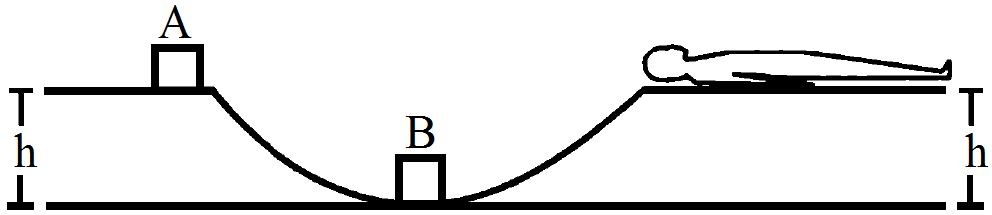
The track shown in figure is frictionless. The block B of mass 2m is lying at rest and the block A of mass m is pushed along the track with some speed. The collision between A and B is perfectly elastic. With what velocity should the block A be started to get the sleeping man awakened?

The bob of a stationary pendulum is given a sharp hit to impart it a horizontal speed of $\sqrt{3\text{gl}}.$ Find the angle rotated by the string before it becomes slack.