An object is at a temperature of ${400^o}C$. At what temperature would it radiate energy twice as fast? The temperature of the surroundings may be assumed to be negligible
Medium
Download our app for free and get started
(d) $\frac{{{E_2}}}{{{E_1}}} = {\left( {\frac{{{T_2}}}{{{T_1}}}} \right)^4}$==> $\frac{2}{1} = {\left( {\frac{{420 + 273}}{T}} \right)^4}$$ = {\left( {\frac{{673}}{T}} \right)^4}$
==> $T = {2^{1/4}} \times 673$ $= 800K.$

Download our appand get started for free
Experience the future of education. Simply download our apps or reach out to us for more information. Let's shape the future of learning together!No signup needed.*
Similar Questions
- 1A cup of tea cools from ${80^0}C$ to ${60^o}C$ in one minute. The ambient temperature is ${30^o}C$. In cooling from ${60^o}C$ to ${50^o}C$ it will take ....... $\sec$View Solution
- 2The rectangular surface of area $8$ cm $ \times $ 4cm of a black body at a temperature of ${127^o}C$ emits energy at the rate of $E$ per second. If the length and breadth of the surface are each reduced to half of the initial value and the temperature is raised to ${327^o}C$, the rate of emission of energy will becomeView Solution
- 3The temperature of a piece of iron is ${27^o}C$ and it is radiating energy at the rate of $Q\;kW{m^{ - 2}}$. If its temperature is raised to ${151^o}C$, the rate of radiation of energy will become approximately ....... $Q\,kW\,{m^{ - 2}}$View Solution
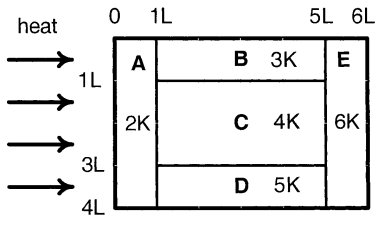
- 4A composite block is made of slabs $A, B, C, D$ and $E$ of different thermal conductivities (given in terms of a constant $K$ ) and sizes (given in terms of length, $L$ ) as shown in the figure. All slabs are of same width. Heat $'Q'$ flows only from left to right through the blocks. Then in steady state $Image$View Solution
$(A)$ heat flow through $A$ and $E$ slabs are same.
$(B)$ heat flow through slab $E$ is maximum.
$(C)$ temperature difference across slab $E$ is smallest.
$(D)$ heat flow through $C =$ heat flow through $B +$ heat flow through $D$.
- 5The length of the two rods made up of the same metal and having the same area of cross-section are $0.6 m$ and $0.8 m$ respectively. The temperature between the ends of first rod is ${90^o}C$ and ${60^o}C$ and that for the other rod is $150^oC$ and ${110^o}C$. For which rod the rate of conduction will be greaterView Solution
- 6If temperature of a black body increases from ${7^o}C$ to ${287^o}C$, then the rate of energy radiation increases byView Solution
- 7A cane is taken out from a refrigerator at $0°C$ . The atmospheric temperature is $25°C$ . If $t_1$ is the time taken to heat from $0°C$ to $5°C$ and $t_2$ is the time taken from $10°C$ to $15°C$, thenView Solution
- 8View SolutionWhich of the following is the correct device for the detection of thermal radiation
- 9View SolutionThe dimensions of thermal resistance are
- 10The two ends of a metal rod are maintained at temperatures $100 ^o C$ and $110^o C$. The rate of heat flow in the rod is found to be $4.0\ J/s$. If the ends are maintained at temperatures $200^o\ C$ and $210^o\ C$, the rate of heat flow will be.... $J/s$View Solution