MCQ
The dimensions of thermal resistance are
  • ${M^{ - 1}}{L^{ - 2}}{T^3}K$
  • B
    $M{L^2}{T^{ - 2}}{K^{ - 1}}$
  • C
    $M{L^2}{T^{ - 3}}K$
  • D
    $M{L^2}{T^{ - 2}}{K^{ - 2}}$

Answer

Correct option: A.
${M^{ - 1}}{L^{ - 2}}{T^3}K$
a
(a)Thermal resistance
$ = \frac{l}{{KA}} = \left[ {\frac{L}{{ML{T^{ - 3}}{K^{ - 1}} \times {L^2}}}} \right] = [{M^{ - 1}}{L^{ - 2}}{T^3}K]$

Need a full question paper?

Generate a complete, print-ready paper with questions like this in minutes — across 16+ boards, with answer keys.
Start Generating Free

Similar questions

In an adiabatic process where in pressure is increased by $\frac{2}{3}\% $ if $\frac{{{C_p}}}{{{C_v}}} = \frac{3}{2},$ then the volume decreases by about
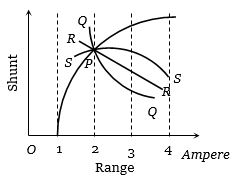
The ammeter has range $1\, ampere$ without shunt. the range can be varied by using different shunt resistances. The graph between shunt resistance and range will have the nature
What does not change in the field of central force
Two particles of masses $M$ and $4M$ are released from a distance $10\,metres$ from each other. Find the point of collision from smaller particle .............. $\mathrm{metres}$
A body of mass $1\,kg$ collides head on elastically with a stationary body of mass $3\,kg$. After collision, the smaller body reverses its direction of motion and moves with a speed of $2\,m / s$. The initial speed of the smaller body before collision is $..........ms ^{-1}$
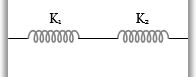
The effective spring constant of two spring system as shown in figure will be
A proton is fired from very far away towards a nucleus with charge $Q=120 \ e$, where $e$ is the electronic charge. It makes a closest approach of $10 \ fm$ to the nucleus. The de Brogle wavelength (in units of $fm$ ) of the proton at its start is :

(take the proton mass, $m _0=(5 / 3) \times 10^{-27} kg , h / e =4.2 \times 10^{-15} J / s / C ; \frac{1}{4 \pi \varepsilon_0}=9 \times 10^9 m / F ; 1 fm =10^{-15} m$ ) 

A block of wood is floating on water at $0^{\circ} C$ with volume $V_0$ above water. When the temperature of water increases from $0$ to $10^{\circ} C$, the change in the volume of the block that is above water is best described schematically by the graph.
The wavelength of the first Balmer line caused by a transition from the $n=3$ level to the $n=2$ level in hydrogen is $\lambda_1$. The wavelength of the line caused by an electronic transition from $n=5$ to $n=3$ is
A rod of length $L$ at room temperature and uniform area of cross section $A$, is made of a metal having coefficient of linear expansion $\alpha {/^o}C$. It is observed that an external compressive force $F$, is applied on each of its ends, prevents any change in the length of the rod, when it temperature rises by $\Delta \,TK$. Young’s modulus, $Y$, for this metal is