MCQ
An object is moving on a circular track of radius $450\, m$. At some instant, the object is moving at $30\, m/s$ and gaining speed at a uniform rate of $2 m/s^2$. Its acceleration at this instant is nearly  .......... $m/s^2$
  • A
    $1.6$
  • B
    $0.8$
  • $2.8$
  • D
    $3.4$

Answer

Correct option: C.
$2.8$
c
$\mathrm{a}=\sqrt{\mathrm{a}_{\mathrm{c}}^{2}+\mathrm{a}_{\mathrm{t}}^{2}}=\sqrt{\left(\frac{\mathrm{V}^{2}}{\mathrm{r}}\right)^{2}+\mathrm{a}_{\mathrm{t}}^{2}}$

$a=\sqrt{\left(\frac{900}{450}\right)^{2}+(2)^{2}}=2.8 \mathrm{m} / \mathrm{s}^{2}$

Need a full question paper?

Generate a complete, print-ready paper with questions like this in minutes — across 16+ boards, with answer keys.

Start Generating Free

Similar questions

Spot the wrong statement :The acceleration due to gravity $‘g’$ decreases if
Two thermometers are used to record the temperature of a room. If the bulb of one is wrapped in wet hanky
The average density of Earth’s crust $10\ km$ beneath the surface is $2.7\ gm/cm^3$ . The speed of longitudinal seismic waves at that depth is $5.4\ km/s$ . The bulk modulus of Earth’s crust considering its behaviour as fluid at that depth is
Consider three quantities $\text{x}=\frac{\text{E}}{\text{B}},\ \text{y}=\sqrt{\frac{1}{\mu_0\in_0}}$ and $\text{z}=\frac{1}{\text{CR}}.$ Here, $l$ is the length of a wire, $C$ is a capacitance and $R$ is a resistance. All other symbols have standard meanings.
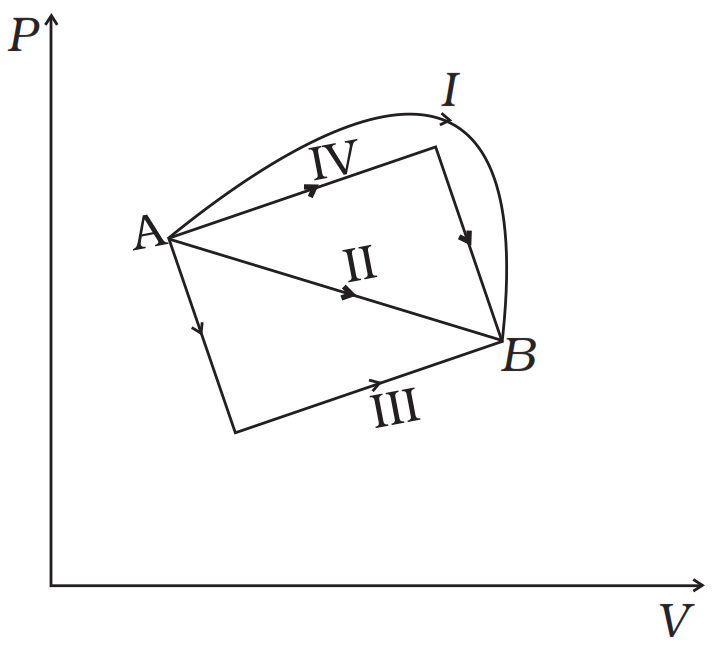
Figure. shows the $P-V$ diagram of an ideal gas undergoing a change of state from $A$ to $B$. Four different parts $\text{I, II, III}$ and $\text{IV}$ as shown in the figure may lead to the same change of state.

 
Which of the following is the graph between the height $(h)$ of a projectile and time $(t)$, when it is projected from the ground
A diatomic gas of molecular mass $40 \,g / mol$ is filled in a rigid container at temperature $30^{\circ} C$. It is moving with velocity $200 \,m / s$. If it is suddenly stopped, the rise in the temperature of the gas is .........
A diatomic molecule has how many degrees of freedom:
One pico Farad is equal to
A large number of droplets, each of radius, $r$ coalesce to form a bigger drop of radius, $R.$ An engineer designs a machine so that the energy released in this process is converted into the kinetic energy of the drop. Velocity of the drop is ($T=$ surface tension, $\rho =$ density)