MCQ
Spot the wrong statement :The acceleration due to gravity $‘g’$ decreases if
  • A
    We go down from the surface of the earth towards its centre
  • B
    We go up from the surface of the earth
  • We go from the equator towards the poles on the surface of the earth
  • D
    The rotational velocity of the earth is increased
Answer

Correct option: C.
We go from the equator towards the poles on the surface of the earth
c
(c) Value of $g$ decreases when we go from poles to equator.

Need a full question paper?

Generate a complete, print-ready paper with questions like this in minutes — across 16+ boards, with answer keys.

Start Generating Free

Similar questions

A player kicks a football with an initial speed of $25\, {ms}^{-1}$ at an angle of $45^{\circ}$ from the ground. What are the maximum height and the time taken by the football to reach at the highest point during motion ? (Take g $=10 \,{ms}^{-2}$ )
The weight of man in a lift moving with same acceleration upwards is $608\,N$ , while the weight of the same man in the life moving down wards with the same acceleration is $368\,N$ . His normal weight is ............ $N$
A satellite is orbiting the earth in a circular orbit of radius $r.$ Its
At the top of the trajectory of a projectile, the directions of its velocity and acceleration are
The reason for the force exerted by a gas on the wall of the vessel is that the molecules of the gas:
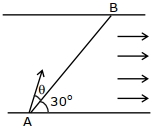
A swimmer wants to cross a river from point $A$ to point $B$. Line $A B$ makes an angle of $30^{\circ}$ with the flow of river. Magnitude of velocity of the swimmer is same as that of the river. The angle $\theta$ with the line ${AB}$ should be $^{\circ}$, so that the swimmer reaches point ${B}$.
How much force is required to produce an increase of $0.2\%$ in the length of a brass wire of diameter $0.6\, mm$ (Young’s modulus for brass = $0.9 \times {10^{11}}N/{m^2}$)
Three liquids of densities $\rho _1,\rho _2$ and $\rho _3$ (with $\rho _1 > \rho _2 > \rho_3),$ having the same value of surface tension $T,$ rise to the same height in three identical capillaries. The angles of contact $\theta_1 \,,\theta_2$ and $\theta_3$ obey  
The principle of conservation of linear momentum can be strictly applied during a collision between two particles provided the time of impact is
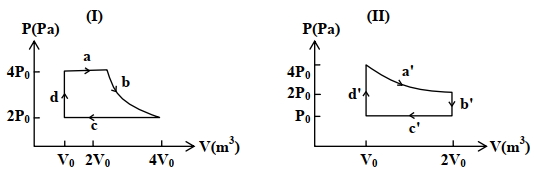
One mole of an ideal gas undergoes two different cyclic processes I and II, as shown in the $P-V$ diagrams below. In cycle I, processes $a, b, c$ and $d$ are isobaric, isothermal, isobaric and isochoric, respectively. In cycle II, processes $a^{\prime}, b^{\prime}, c^{\prime}$ and $d^{\prime}$ are isothermal, isochoric, isobaric and isochoric, respectively. The total work done during cycle I is $W_I$ and that during cycle II is $W_{I I}$. The ratio $W_I / W_{I I}$ is . . . .

(image)