MCQ
An object is moving with variable speed, then
  • A
    Its velocity may be zero
  • Its velocity must be variable
  • C
    Its acceleration may be zero
  • D
    Its velocity may be constant

Answer

Correct option: B.
Its velocity must be variable
b
(b)

If speed is changing then velocity must change.

Need a full question paper?

Generate a complete, print-ready paper with questions like this in minutes — across 16+ boards, with answer keys.
Start Generating Free

Similar questions

A sonometer wire oflength $1.5\ m$ is made of steel. The tension in it produces an elastic strain of $1 \%$. What is the fundamental frequency of steel if density and elasticity of steel are $7.7 \times 10^3 $ $kg/m^3$ and $2.2 \times 10^{11}$ $N/m^2$ respectively?
A boy is sitting on the horizontal platform of a joy wheel at a distance of $5 \,m$ from the center. The wheel begins to rotate and when the angular speed exceeds $1 \,rad / s$, the boy just slips. The coefficient of friction between the boy and the wheel is $\left(g=10 \,m / s ^2\right)$
If a body moving in circular path maintains constant speed of $10\,ms^{-1},$ then which of the following correctly describes relation between acceleration and radius ?
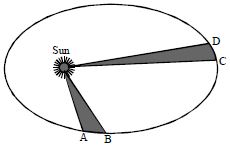
The fig. shows the motion of a planet around the un in an elliptical orbit with sun at the  focus. The shaded areas can be assumed to be equal. If $t_1$ and $t_2$ represent the  time taken for the planet to move from $A$ to $B$ and $C$ to $D$ respectively, then
A particle covers $50\, m$ distance when projected with an initial speed. On the same surface it will cover a distance, when projected with double the initial speed ......... $m$
A listener is at rest with respect to the source of sound. A wind starts blowing along the line joining the source and the observer. Which of the following quantities do not change?
  1. Frequency.
  2. Velocity of sound.
  3. Wavelength.
  4. Time period.
A particle moves in a circle of radius $25\, cm$ at two revolutions per second. The acceleration of the particle in $meter/second^2$ is
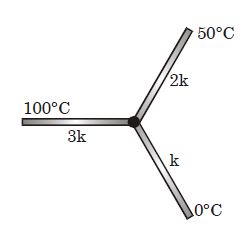
Three rods of the same dimensions have thermal conductivities $3k, 2k$ and $k$. They are arranged as shown, with their ends at $100\,^oC, 50\,^oC$ and $0\,^oC$. The temperature of their junction is
A metal rod $\mathrm{AB}$ of length $10 x$ has its one end $\mathrm{A}$ in ice at $0^{\circ} \mathrm{C}$ and the other end $\mathrm{B}$ in water at $100^{\circ} \mathrm{C}$. If a point $\mathrm{P}$ on the rod is maintained at $400^{\circ} \mathrm{C}$, then it is found that equal amounts of water and ice evaporate and melt per unit time. The latent heat of evaporation of water is $540 \ \mathrm{cal} / \mathrm{g}$ and latent heat of melting of ice is $80 \ \mathrm{cal} / \mathrm{g}$. If the point $\mathrm{P}$ is at a distance of $\lambda x$ from the ice end $\mathrm{A}$, find the value of $\lambda$.

[Neglect any heat loss to the surrounding.|

A gas is filled in a cylinder, its temperature is increased by $20\%$ on Kelvin scale and volume is reduced by $10\%.$ How much percentage of the gas will leak out ........ $\%$