MCQ
An object is placed first at infinity and then at $20 cm$ from the object side focal plane of the convex lens. The two images thus formed are $5 cm$ apart. The focal length of the lens is......$cm$
  • A
    $5$
  • $10$
  • C
    $15 $
  • D
    $20$

Answer

Correct option: B.
$10$
b
(b) For first case : $\frac{1}{f} = \frac{1}{v} - \frac{1}{\infty } \Rightarrow f = v$
For second case $\frac{1}{f} = \frac{1}{{(f + 5)}} - \frac{1}{{ - (f + 20)}} \Rightarrow f = 10\,\,cm$
Alternative sol. -${f^2} = {x_1}{x_2}$ ==> $f = 10cm.$

Need a full question paper?

Generate a complete, print-ready paper with questions like this in minutes — across 16+ boards, with answer keys.
Start Generating Free

Similar questions

A sound source is moving towards a stationary observer with $1/10$ of the speed of sound. The ratio of apparent to real frequency is
The resistor of resistance '$R$' is connected to $25\, V$ supply and heat produced in it is $25\, J/sec$. The value of $R$ is .......... $\Omega $
Two trains, one coming towards and another going away from an observer both at $4\; m/s$ produce whistle simultaneously of frequency $300 \;Hz$. Find the number of beats produced
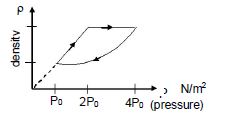
An ideal gas undergoes cyclic process as shown in density pressure graph. During the process $AB$ the work done $|W_{AB}| = 70\,J$ . During the process $BC$, the gas absorbs $150\,J$ of heat. During the process $CA$ , gas undergoes expansion and does $210\,J$ of work
Velocity of a body moving along a straight line with uniform acceleration $a$ reduces by $\frac{3}{4}$ of its initial velocity in time $t_0$. The total time of motion of the body till its velocity becomes zero is
A plano-convex lens is made of a material of refractive index $n$. When a small object is placed $30 \mathrm{~cm}$ away in front of the curved surface of the lens, an image of double the size of the object is produced. Due to reflection from the convex surface of the lens, another faint image is observed at a distance of $10 \mathrm{~cm}$ away from the lens. Which of the following statement($s$) is(are) true?

($A$) The refractive index of the lens is $2.5$

($B$) The radius of curvature of the convex surface is $45 \mathrm{~cm}$

($C$) The faint image is erect and real

($D$) The focal length of the lens is $20 \mathrm{~cm}$

When the light of frequency $2v_0$ (where $v_0$ is threshold frequency), is incident on a metal plate , the maximum velocity of electrons emitted is $v_1$. When the frequency of the incident radiation is increased to $5v_0,$ the maximum velocity of electrons emitted from the same plate is $v_2$. The ratio of $v_1$ to $v_2$ is
A double charged lithium atom is equivalent to hydrogen whose atomic number is $3$. The wavelength of required radiation for emitting electron from first to third Bohr orbit in $L{i^{ + + }}$ will be.......$\mathop A\limits^o $ (Ionisation energy of hydrogen atom is $13.6\,eV$)
A thin rod of length$f/3$ lies along the axis of a concave mirror of focal length $f.$ One end of its magnified image touches an end of the rod. The length of the image is
When phosphorus and antimony are mixed in zermaniun, then