Question
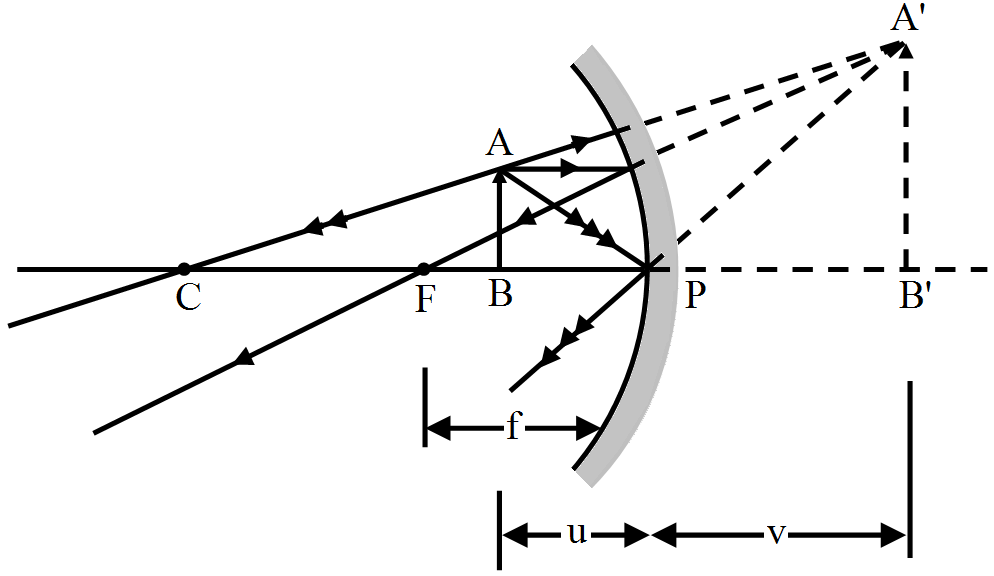
  1. An object is placed in front of a concave mirror. It is observed that a virtual image is formed. Draw the ray diagram to show the image formation and hence derive the mirror equation $\frac{1}{\text{f}}=\frac{1}{\text{u}}+\frac{1}{\text{v}}.$
  2. An object is placed 30cm in front of a plano-convex lens with its spherical surface of radius of curvature 20cm. If the refractive index of the material of the lens is 1.5, find the position and nature of the image formed.
Answer

  1.  

$\triangle\text{ABC}\sim\triangle\text{A}_1\text{B}_1\text{C}$
$\Rightarrow\frac{\text{A}_1\text{B}_1}{\text{AB}}=\frac{\text{A}_1\text{C}}{\text{AC}}=\frac{(+\text{v})+(-\text{R)}}{(-\text{R})-(-\text{u)}}\ ...(1)$
$\triangle\text{ABP}\sim\triangle\text{A}_1\text{B}_1\text{P}$
$\Rightarrow\frac{\text{A}_1\text{B}_1}{\text{AB}}=\frac{\text{A}_1\text{P}}{\text{AP}}=\frac{+\text{v}}{-\text{u}}\ ...(2)$
$(1)=(2)$
$\Rightarrow\frac{\text{v}-\text{R}}{-\text{R}+\text{u}}=\frac{\text{v}}{-\text{u}}$
$\Rightarrow-\text{uv}+\text{uR}=-\text{vR}+\text{uv}$
$\Rightarrow\text{uR}+\text{vR}=2\text{uv}$
$\div\text{ by }\text{uvR}$
$\Rightarrow\frac{1}{\text{v}}+\frac{1}{\text{u}}=\frac{2}{\text{R}}$
$\because\text{R}=2\text{F}$
$\therefore\frac{1}{\text{v}}+\frac{1}{\text{u}}=\frac{1}{\text{f}}$
  1. $\frac{1}{\text{f}}=(1.5-1)\Big(\frac{1}{20}-\frac{1}{\infty}\Big)$
$=\frac{0.5}{20}=\frac{5}{200}=\frac{1}{40}$
$\therefore\text{f}=40\text{cm}$
Now, $\frac{1}{\text{f}}=\frac{1}{\text{v}}-\frac{1}{\text{v}}$
$\Rightarrow\text{v}=\frac{\text{fu}}{\text{f}+\text{u}}=\frac{40\times-30}{40-30}$
$\Rightarrow\text{v}=\frac{-40\times30}{10}=-120\text{cm}$
Image is virtual, erect and enlarged in front of lens 120cm away.

Need a full question paper?

Generate a complete, print-ready paper with questions like this in minutes — across 16+ boards, with answer keys.

Start Generating Free

Similar questions

Two particles $A$ and $B$ of de Broglie wavelengths $\lambda _1$ and $\lambda _2$ combine to form a particle $C$. The process conserves momentum. Find the de Broglie wavelength of the particle $C. \ ($The motion is one dimensional$)$.
When a proton is released from rest in a room, it starts with an initial acceleration $a_0$ towards west. When it is projected towards north with a speed $v_0,$ it moves with an initial acceleration $3a_0$ towards west. Find the electric field and the maximum possible magnetic field in the room.
A screen is placed 90 cm from an object. The image of the object on the screen is formed by a convex lens at two different locations separated by 20 cm. Determine the focal length of the lens.
A parallel$-$plate capacitor has plate area $100\ cm^2$ and plate separation $1.0\ cm.$ A glass plate $($dielectric constant $6.0)$ of thickness $6.0\ mm$ and an ebonite plate $($dielectric constant $4.0)$ are inserted one over the other to fill the space between the plates of the capacitor. Find the new capacitance.
A beam of monochromatic light of wavelength $\lambda$ ejects photoelectrons from a cesium surface $\big(\Phi=1.9\text{eV}\big).$ These photoelectrons are made to collide with hydrogen atoms in ground state. Find the maximum value of $\lambda$ for which (a) hydrogen atoms may be ionized, (b) hydrogen atoms may get excited from the ground state to the first excited state and (c) the excited hydrogen atoms may emit visible light.
One day Chetan’s mother developed a severe stomach ache all of a sudden. She was rushed to the doctor who suggested for an immediate endoscopy test and gave an estimate of expenditure for the same. Chetan immediately contacted his class teacher and shared the information with her. The class teacher arranged for the money and rushed to the hospital. On realising that Chetan belonged to a below average income group family, even the doctor offered concession for the test fee. The test was conducted successfully.
Answer the following questions based on the above information:
  1. Which principle in optics is made use of in endoscopy?
  2. Briefly explain the values reflected in the action taken by the teacher.
  3. In what way do you appreciate the response of the doctor on the given situation?
Three equal masses m are placed at the three corners of an equilateral triangle of side a. Find the force exerted by this system on another particle of mass m placed at,
  1. The mid-point of a side,
  2. At the centre of the triangle.
In beta decay, an electron (or a positron) is emitted by a nucleus. Does the remaining atom get oppositely charged?
A beam of white light is incident normally on a plane surface absorbing 70% of the light and reflecting the rest. If the incident beam carries 10W of power, find the force exerted by it on the surface.
Consider a given sample of an ideal gas $\Big(\frac{\text{C}_\text{P}}{\text{C}_\text{V}}=\gamma\Big)$ having initial pressure $P_0$ and volume $V_0.$​​​​​​​
  1. The gas is isothermally taken to a pressure $\frac{\text{P}_0}{2}$ and from there, adiabatically to a pressure $\frac{\text{P}_0}{4}.$ Find the final volume.
  2. The gas is brought back to its initial state. It is adiabatically taken to a pressure $\frac{\text{P}_0}{2}$ and from there, isothermally to a pressure $\frac{\text{P}_0}{4}.$ Find the final volume.