Question
Two particles $A$ and $B$ of de Broglie wavelengths $\lambda _1$ and $\lambda _2$ combine to form a particle $C$. The process conserves momentum. Find the de Broglie wavelength of the particle $C. \ ($The motion is one dimensional$)$.

Answer

By the law of conservation of momentum,
$|p_C| = |p_A| + |p_B|$
Let us first take the case $I$ when both $p_A$ and $p_B$ are positive
then $\lambda_\text{C}=\frac{\lambda_\text{A}\lambda_\text{B}}{\lambda_\text{A}+\lambda_\text{B}}$
In case $III $ when $p_A > 0, p_B < 0$
i.e., $p_A$ is positive and $p_B$ is negative,
$\frac{\text{h}}{\lambda_\text{C}}=\frac{\text{h}}{\lambda_\text{A}}-\frac{\text{h}}{\lambda_\text{B}}=\frac{(\lambda_\text{B}-\lambda_\text{A})\text{h}}{\lambda_\text{A}\lambda_\text{B}}$
$\Rightarrow\ \lambda_\text{C}=\frac{\lambda_\text{A}\lambda_\text{B}}{\lambda_\text{B}-\lambda_\text{A}}$
And in case $IV$ when $p_A < 0, p_B > 0,$
i.e., $p_A$ is negative and $p_B$ is positive.
$\therefore\ \frac{\text{h}}{\lambda_\text{C}}=\frac{-\text{h}}{\lambda_\text{A}}+\frac{\text{h}}{\lambda_\text{B}}$
$\Rightarrow\ \frac{(\lambda_\text{A}-\lambda_\text{B})\text{h}}{\lambda_\text{A}\lambda_\text{B}}$
$\Rightarrow\ \lambda_\text{C}=\frac{\lambda_\text{A}\lambda_\text{B}}{\lambda_\text{A}-\lambda_\text{B}}$

Need a full question paper?

Generate a complete, print-ready paper with questions like this in minutes — across 16+ boards, with answer keys.
Start Generating Free

Similar questions

Two tiny spheres carrying charges $1.5 \mu C$ and $2.5 \mu C$ are located $30 \ cm$ apart. Find the potential and electric field:
  1. At the mid $-$ point of the line joining the two charges, and
  2. At a point $10 \ cm$ from this midpoint in a plane normal to the line and passing through the mid-point.
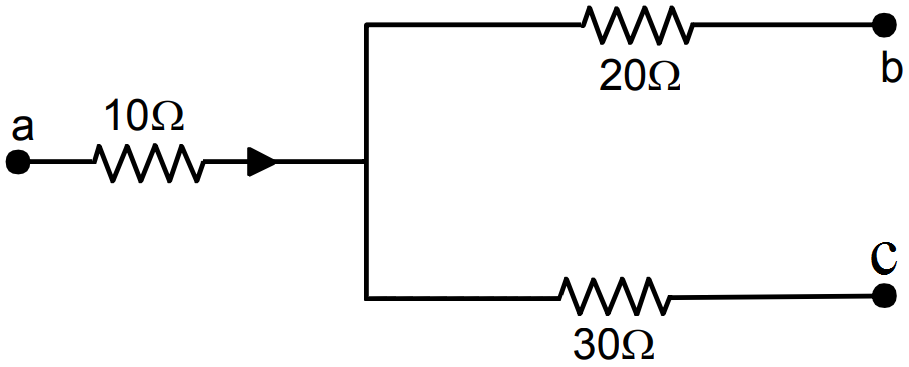
Figure. showa a part of an electric circuit. The potentials at the point a, b and c are 30V, 12V and 2V respectively. Find the currents through the three resistors.
A source emitting sound at frequency 4000Hz, is moving along the Y-axis with a speed of 22m/s. A listener is situated on the ground at the position (660m, 0). Find the frequency of the sound received by the listener at the instant the source the origin. Speed of sound in air = 330m/s.
$a.$ Derive the expression for the current flowing in an ideal capacitor and its reactance when connected to an ac source of voltage $V = V _{ o } \sin \omega t$.
$b.$ Draw its phasor diagram.
$c.$ If resistance is added in series to capacitor what changes will occur in the current flowing in the circuit and phase angle between voltage and current.
An electrical technician requires a capacitance of $2\mu F$ in a circuitacross a potential difference of $1kV. A$ large number of $1\mu F$ capacitors are available to him each of which can withstand a potential difference of not more than $400V$. Suggest a possible arrangement that requires the minimum number of capacitors.
A mercury lamp is a convenient source for studying frequency dependence of photoelectric emission,
Since it gives a number of spectral lines ranging from the $UV$ to the red end of the visible spectrum. In our experiment with rubidium photo $-$ cell, the following lines from a mercury source were used:
$\lambda_1=3650\ \mathring{\text{A}},\ \lambda_2=4047\ \mathring{\text{A}},\ \lambda_3=4358\ \mathring{\text{A}},\ \lambda_4=5461\ \mathring{\text{A}},\ \lambda_5=6907\ \mathring{\text{A}},$
The stopping voltages, respectively, were measured to be:
$V_{01} = 1.28 V, V_{02} = 0.95 V, V_{03} = 0.74 V, V_{04} = 0.16 V, V_{05} = 0 V$
Determine the value of Planck’s constant h, the threshold frequency and work function for the material.
[Note: You will notice that to get h from the data, you will need to know $e \ ($which you can take to be $1.6 \times 10^{–19} C)$. Experiments of this kind on $\text{Na, Li, K,}$ etc. were performed by Millikan, who, using his own value of e $($from the oil $-$ drop experiment) confirmed Einstein’s photoelectric equation and at the same time gave an independent estimate of the value of $h.]$
Write Einstein's photoelectric equation and explain any two observations related to the photoelectric effect.
What is transformer ? Describe its construction and working principle.
A normal eye has retina 2cm behind the eye-lens. What is the power of the eye-lens when the eye is
  1. Fully relaxed,
  2. Most strained?
Two wires of equal length, one of aluminium and the other of copper have the same resistance. Which of the two wires is lighter? Hence explain why aluminium wires are preferred for overhead power cables.
$(\rho_{\text{A}1}=2.63\times10^{-8}\Omega\ \text{m,}$ Relative density of $Al=2.7,\ \text{of Cu}=8.9)$