Question
An object is projected from ground with speed $20 \,m / s$ at angle $30^{\circ}$ with horizontal. Its centripetal acceleration one second after the projection is .......... $m / s ^2$ [Take $g=10 \,m / s ^2$ ]

Answer

(a)

$T =\frac{2u \sin \theta}{g}$

$=\frac{2 \times 20 \times 1 / 2}{10}=2 \sec$

$t=1$ partical at highest point

$a_c=g=10 m / s ^2$

Need a full question paper?

Generate a complete, print-ready paper with questions like this in minutes — across 16+ boards, with answer keys.
Start Generating Free

Similar questions

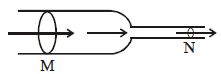
Horizontal tube of non-uniform cross-section has radii of  $0.1\,m$ and  $0.05\,m$ respectively at $M$  and  $N.$  For a stream-line flow of liquid the rate of liquid flow is
Two waves have equations $x_1=a \sin \left(\omega t+\phi_1\right)$ and $x_2=a \sin \left(\omega t+\phi_2\right)$. If in the resultant wave the frequency and amplitude remain equal to amplitude of superimposing waves, the phase difference between them is ........
Aball of mass $m$ is thrown vertically upwards.Assume the force of air resistance has magnitude proportional to the velocity, and direction opposite to the velocity's. At the highest point, the ball's acceleration is
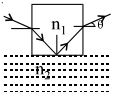
$A$ cubical block of glass of refractive index $n_1$ is in contact with the surface of water of refractive index $n_2$. A beam of light is incident on vertical face of the block (see figure). After refraction, a total internal reflection at the base and refraction at the opposite vertical face, the ray emerges out at an angle $\theta$ . The value of $\theta$ is given by :
A radioactive substance has a half-life of $1$ year. The fraction of this material, that would remain after $5$ years will be
A body floats in a liquid contained in a beaker. The whole system as shown falls freely under gravity. The upthrust on the body due to the liquid is
Which one of the following on oxidation will not give a carboxylic acid with the same number of carbon atoms
Given below are two statements:

Statement $I:$ Rotation of the earth shows effect on the value of acceleration due to gravity $(g)$.

Statement $II:$ The effect of rotation of the earth on the value of $g$ at the equator is minimum and that at the pole is maximum.

In the light of the above statements, choose the correct answer from the options given below.

A convex lens of focal length 0.12 m produces a virtual image which is thrice the size of the object. Find the distance between the object and the lens.
Huygen’s principle of secondary wavelets may be used to