A body floats in a liquid contained in a beaker. The whole system as shown falls freely under gravity. The upthrust on the body due to the liquid is

IIT 1982, Medium
Download our app for free and get started
(a)Upthrust $ = V{\rho _{{\rm{liquid}}}}(g - a)$
where, $a = $ downward acceleration,
$V = $ volume of liquid displaced
But for free fall $ a = g $ $\therefore $ $Upthrust = 0$
where, $a = $ downward acceleration,
$V = $ volume of liquid displaced
But for free fall $ a = g $ $\therefore $ $Upthrust = 0$

Download our appand get started for free
Experience the future of education. Simply download our apps or reach out to us for more information. Let's shape the future of learning together!No signup needed.*
Similar Questions
- 1Three identical vessels are filled to the same height with three different liquids $A, B$ and $C$ $({\rho _A} > {\rho _B} > {\rho _C})$. The pressure at the base will beView Solution
- 2Two tubes of radii $r_1$ and $r_2$, and lengths $l_1$ and $l_2$, respectively, are connected in series and a liquid flows through each of them in streamline conditions. $P_1$ and $P_2$ are pressure differences across the two tubes. If $P_2$ is $4P_1$ and $l_2$ is $ \frac{l_1}{4}$ , then the radius $r_2$ will be equal toView Solution
- 3A bubble of radius $R$ in water of density $\rho$ is expanding uniformly at speed $v$. Given that water is incompressible, the kinetic energy of water being pushed isView Solution
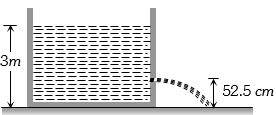
- 4Water is filled in a cylindrical container to a height of $3m. $ The ratio of the cross-sectional area of the orifice and the beaker is $ 0.1. $ The square of the speed of the liquid coming out from the orifice is ....... $m^2/s^2$ ($g = 10 m/s^2$)View Solution
- 5Equal masses of water and a liquid of density $ 2$ are mixed together, then the mixture has a density of ........ $ g / cm^3$View Solution
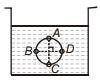
- 6Figure shows a container filled with a liquid of density $\rho$. Four points $A, B, C$ and $D$ lie on the diametrically opposite points of a circle as shown. Points $A$ and $C$ lie on vertical line and points $B$ and $D$ lie on horizontal line. The incorrect statement is $\left(p_A, p_B, p_C, p_D\right.$ are absolute pressure at the respective points)View Solution
- 7View SolutionA tank filled with fresh water has a hole in its bottom and water is flowing out of it. If the size of the hole is increased, then
- 8A wide vessel with a small hole at the bottom is filled with two liquids. The density and heightof one liquid are $\rho_1$ and $h_1$ and that of the otherare $\rho_2$ and $h_2 \ (\rho_1 >\rho_2)$. The velocity of liquid coming out of the hole is :View Solution
- 9A cyclindrical vessel of cross-sectional area $1000$ $cm^2$, is fitted with a frictionless piston of mass $10$ $kg$, and filled with water completely.A small hole of cross-sectional area $10$ $mm^2$ is opened at a point $50$ $cm$ deep from the lower surface of the piston. The velocity of efflux from the hole will be ........... $m/s$View Solution
- 10The cross sectional area of a horizontal tube increases along its length linearly, as we move in the direction of flow. The variation of pressure, as we move along its length in the direction of flow ($x-$ direction), is best depicted by which of the following graphsView Solution