Question
An object moving in a circular path at constant speed has constant

Answer

(a)

An object undergoing uniform circular motion is moving with a constant speed nonetheless, it is accelerating due to its change in direction. The direction of the acceleration is inwards. An object moving in uniform circular motion will cover the same linear distance in each second of time(constant speed)

Need a full question paper?

Generate a complete, print-ready paper with questions like this in minutes — across 16+ boards, with answer keys.

Start Generating Free

Similar questions

A point moves in a straight line so that its displacement $x\,m$ at time $t\,sec$ is given by $x^2 = 1 + t^2$. Its acceleration in $m/sec^2$ at a time $t\,sec$ is
Diameter of the moon is $3.5\times10^3\, km$ and its distance from earth is $3.8\times10^5\, km$. It is seen by a telescope whose objective and eyepiece have focal lengths $4\, m$ and $10\, cm$ respectively. What will the angular diameter of the image of the moon?.......$^o$
$y = a\cos (kx + \omega t)$ superimposes on another wave giving a stationary wave having node at $x = 0.$ What is the equation of the other wave
$4 eV$ is the energy of the incident photon and the work function in $2eV.$ What is the stopping potential ............. $V$ 
A block of mass $10\, kg$ moving at $10\,m/s$ is released to slide on rough surface having  coefficient of friction $0.2.$ It will stop by travelling distance ........ $m$
A projectile is fired at an angle of $45^o $ with the horizontal . Elevation angle of the projectile at its highest point as seen from the point of projection, is 
This question has Statement $-1$ and Statement $-2$ Of the four choices given after the Statements, choose the one that best describes the two Statements

Statement $1$ : No work is required to be done to move a test charge between any two points on an equipotential surface

Statement $2$ : Electric lines of force at the equipotential surfaces are mutually perpendicular to each other
An electron having charge ‘$e$’ and mass ‘$m$’ is moving in a uniform electric field $E$. Its acceleration will be
In the Young’s double slit experiment with sodium light. The slits are $0.589 m$ a part. The angular separation of the third maximum from the central maximum will be (given $\lambda$ $= 589 mm$)
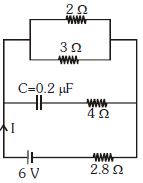
In the given figure the steady state current $I$ is ................. $\mathrm{A}$