A block of mass $10\, kg$ moving at $10\,m/s$ is released to slide on rough surface having coefficient of friction $0.2.$ It will stop by travelling distance ........ $m$
Medium
Download our app for free and get started
$S=\frac{V^{2}}{2 \mu g}=\frac{10^{2}}{2 \times 0.2 \times 10}=25 \mathrm{m}$

Download our appand get started for free
Experience the future of education. Simply download our apps or reach out to us for more information. Let's shape the future of learning together!No signup needed.*
Similar Questions
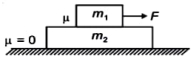
- 1In the given arrangement the maximum value of $F$ for which there is no relative motion between the blocksView Solution
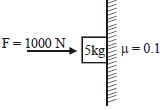
- 2For the given figure, if block remains in equilibrium position then find frictional force between block and wall ........ $N$View Solution
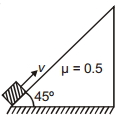
- 3A body is sliding down an inclined plane (angle of inclination $45^o$). If the coefficient of friction is $0.5$ and $g = 9.8\, m/s^2$. then the acceleration of the body downwards in $m/s^2$ isView Solution
- 4An unbanked curve has a radius of $60\,m$. The maximum speed at which a car can make a turn if the coefficient of static friction is $0.75$, is ...... $m/s$View Solution
- 5A block of mass $1 \,kg$ is projected from the lowest point up along the inclined plane. If $g=10 \,ms ^{-2}$, the retardation experienced by the block is ............. $ms ^ {-2}$View Solution
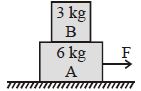
- 6Two blocks $A$ and $B$ of masses $6\, kg$ and $3\, kg$ rest on a smooth horizontal surface as shown in the figure. If coefficient of friction between $A$ and $B$ is $0.4$, the maximum horizontal force which can make them without separation is ........ $N$View Solution
- 7A $2\,kg$ block slides on a horizontal floor with a speed of $4\, m/s$. It strikes a uncompressed spring, and compresses it till the block is motionless. The kinetic friction force is $110\,N$ and spring constant is $1000\, N/m$. The spring compresses by ........ $cm$View Solution
- 8A uniform wooden stick of mass $1.6 \mathrm{~kg}$ and length $l$ rests in an inclined manner on a smooth, vertical wall of height $h( < l)$ such that a small portion of the stick extends beyond the wall. The reaction force of the wall on the stick is perpendicular to the stick. The stick makes an angle of $30^{\circ}$ with the wall and the bottom of the stick is on a rough focr. The reaction of the wall on the stick is equal in magnitude to the reaction of the floor on the st $ck$. The ratio $h / l$ and the frictional force $f$ at the bottom of the stick are $\left(g=10 \mathrm{~m} \mathrm{~s}^{-2}\right)$View Solution
- 9A plank is resting on a horizontal ground in the northern hemisphere of the earth at a $45^{\circ}$ latitude. Let the angular speed of the earth be $\omega$ and its radius $r_e$. The magnitude of the frictional force on the plank will beView Solution
- 10A particle of mass $m$ is executing uniform circular motion on a path of radius $r$. If $p$ is the magnitude of its linear momentum. The radial force acting on the particle isView Solution