An object of mass $m$ is suspended at the end of a massless wire of length $L$ and area of cross$-$section, $A$. Young modulus of the material of the wire is $Y$. If the mass is pulled down slightly its frequency of oscillation along the vertical direction is
JEE MAIN 2020, Medium


Download our appand get started for free
Experience the future of education. Simply download our apps or reach out to us for more information. Let's shape the future of learning together!No signup needed.*
Similar Questions
- 1View SolutionIn case of a forced vibration, the resonance wave becomes very sharp when the
- 2A mass m oscillates with simple harmonic motion with frequency $f = \frac{\omega }{{2\pi }}$ and amplitude A on a spring with constant $K$ , thereforeView Solution
- 3The period of oscillation of a mass $M$ suspended from a spring of negligible mass is $T$. If along with it another mass $M$ is also suspended , the period of oscillation will now beView Solution
- 4A block of mass $m$ attached to massless spring is performing oscillatory motion of amplitude $'A'$ on a frictionless horizontal plane. If half of the mass of the block breaks off when it is passing through its equilibrium point, the amplitude of oscillation for the remaining system become $fA.$ The value of $f$ isView Solution
- 5A particle performing $SHM$ is found at its equilibrium at $t = 1\,sec$. and it is found to have a speed of $0.25\,m/s$ at $t = 2\,sec$. If the period of oscillation is $6\,sec$. Calculate amplitude of oscillationView Solution
- 6Infinite springs with force constant $k$, $2k$, $4k$ and $8k$.... respectively are connected in series. The effective force constant of the spring will beView Solution
- 7The amplitude and the periodic time of a $S.H.M.$ are $ 5\,cm$ and $6\,sec$ respectively. At a distance of $2.5\,cm$ away from the mean position, the phase will beView Solution
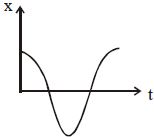
- 8Dispacement time graph of a particle executing $SHM$ is as shown in the figure. Corresponding graph between $PE$ and time isView Solution
- 9Which of the following quantities are always negative in a $SHM$View Solution
- 10A simple harmonic oscillator of angular frequency $2\,rad\,s^{-1}$ is acted upon by an external force $F = sin\,t\,N .$ If the oscillator is at rest in its equilibrium position at $t = 0,$ its position at later times is proportional toView Solution