MCQ
An object will continue moving uniformly until
  • A
    The resultant force acting on it begins to decrease
  • The resultant force on it is zero
  • C
    The resultant force is at right angle to its rotation
  • D
    The resultant force on it is increased continuously
Answer

Correct option: B.
The resultant force on it is zero
b
The object is remains in acceleration until its resultant force on it is zero.

Need a full question paper?

Generate a complete, print-ready paper with questions like this in minutes — across 16+ boards, with answer keys.

Start Generating Free

Similar questions

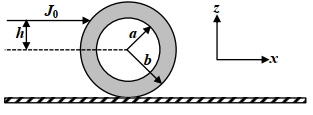
An annular disk of mass $M$, inner radius $a$ and outer radius $b$ is placed on a horizontal surface with coefficient of friction $\mu$, as shown in the figure. At some time, an impulse $J_0 \hat{x}$ is applied at a height $\mathrm{h}$ above the center of the disk. If $h=h_m$ then the disk rolls without slipping along the $x$-axis. Which of the following statement(s) is(are) correct?

(image)

($A$) For $\mu \neq 0$ and $a \rightarrow 0, h_m=b / 2$

($B$) For $\mu \neq 0$ and $a \rightarrow b, h_m=b$

($C$) For $h=h_m$, the initial angular velocity does not depend on the inner radius $a$.

($D$) For $\mu=0$ and $h=0$, the wheel always slides without rolling.

If $F=2 x^2-3 x-2$, then select the correct statement
A body of mass $4\, kg$ moving with velocity $12 \,m/s$ collides with another body of mass $6\, kg$ at rest. If two bodies stick together after collision, then the loss of kinetic energy of system is .............. $J$
What is the distance of the centre of mass of a half ring from its centre if its radius is 0.5 m?
A sphere strikes a wall and rebounds with coefficient of restitution $1/3$. If it rebounds with a velocity of $0.1\, m/sec$ at an angle of $60^o$ to the normal to the wall, the loss of kinetic energy is
A long cylindrical pipe of radius $20 \,cm$ is closed at its upper end and has an airtight piston of negligible mass as shown. When a $50 \,kg$ mass is attached to the other end of the piston, it moves down. If the air in the enclosure is cooled from temperature $T$ to $T-\Delta T$, the piston moves back to its original position. Then $\Delta T / T$ is close to (Assuming air to be an ideal gas, $g=10 \,m / s ^2$, atmospheric pressure is $10^5 \,Pa$ )
A particle is projected with a velocity of $30\,m / s$, at an angle of $\theta_0=\tan ^{-1}\left(\frac{3}{4}\right)$ After $1\,s$, the particle is moving at an angle $\theta$ to the horizontal, where $\tan \theta$ will be equal to $\left(g=10\,m / s ^2\right)$
If $\overrightarrow{ a }= a _{ x } \hat{ i }+ a _{ y } \hat{ j }+ a _{ z } \hat{ k }$ and $\overrightarrow{ b }= b _{ x } \hat{ i }+ b _{ y } \hat{ j }+ b _{ z } \hat{ k }$ then the cross product $\overrightarrow{ a } \times \overrightarrow{ b }$ is given by:
What is the position vector of a point mass moving on a circular path of radius of $10m$ with angular frequency of $2 \text{rads}^{-1}$ after $\frac{\pi}{8}\text{s}?$ Initially the point was on $Y-$axis.
A man of mass $100\,kg$. is standing on a platform of mass $200\,kg$. which is kept on a smooth ice surface. If the man starts moving on the platform with a speed $30\,m / sec$ relative to the platform then calculate with what velocity relative to the ice the platform will recoil $..........m/s$