MCQ
If $F=2 x^2-3 x-2$, then select the correct statement
  • A
    $x=2$ is the position of stable equilibrium
  • B
    $x=-\frac{1}{2}$ is the position of unstable equilibrium
  • $x=-\frac{1}{2}$ is the position of stable equilibrium
  • D
    $x=2$ is the position of neutral equilibrium
Answer

Correct option: C.
$x=-\frac{1}{2}$ is the position of stable equilibrium
c
(c)

$F=2 x^2-3 x-2$

Putting $F=0$

$2 x^2-3 x-2=0$

$2 x^2-4 x+x-2=0$

$2 x(x-2)+(x-2)=0$

$(x-2)(2 x+1)=0$

$\Rightarrow x=2, \quad x=\frac{-1}{2}$

$\frac{d^2 v}{d x^2}=\frac{-d F}{d x}=-(4 x-3)$

at $x=\frac{-1}{2}$

$\frac{d^2 v}{d x^2} > 0 \quad \Rightarrow$ Stable equilibrium

Need a full question paper?

Generate a complete, print-ready paper with questions like this in minutes — across 16+ boards, with answer keys.

Start Generating Free

Similar questions

It is found that if a neutron suffers an elastic collinear collision with deuterium at rest, fractional loss of its energy is $p_d $ ; while for its similar collision with carbon nucleus at rest, fractional loss of energy is $P_c$. The values of $P_d$ and $P_c$ are respectively
Karman line is a theoretical construct that separates the earth's atmosphere from outer space. It is defined to be the height at which the lift on an aircraft flying at the speed of a polar satellite $(8 \,km / s )$ is equal to its weight. Taking a fighter aircraft of wing area $30 \,m ^2$, and mass $7500 \,kg$, the height of the Karman line above the ground will be in the range .............. $km$ (assume the density of air at height $h$ above ground to be $\rho( h )=1.2 e ^{\frac{ h }{10}} \,kg / m ^3$ where $h$ is in $km$ and the lift force to be $\frac{1}{2} \rho v^2 A$, where $v$ is the speed of the aircraft and $A$ its wing area).
 A certain body weighs $22.42\;g$ and has a measured volume of $4.7 \;cc .$ The possible error in the measurement of mass and volume are $0.01\; gm$ and $0.1 \;cc .$
Then maximum error in the density will be
A dimensionally consistent relation for the volume V of a liquid of coefficient of viscosity ' $\eta$ ' flowing per second, through a tube of radius $r$ and length / and having a pressure difference $P$ across its ends, is
A cylinder of $10 \,kg$ is sliding in a plane with an initial velocity of $10 \,m/s$. If the coefficient of friction between the surface and cylinder is $0.5$ then before stopping, it will cover. $(g = 10\,\,m/{s^2})$ ........ $m$
A certain amount of gas of volume $V$ at $27^{o}\,C$ temperature and pressure $2 \times 10^{7} \;Nm ^{-2}$ expands isothermally until its volume gets doubled. Later it expands adiabatically until its volume gets redoubled. The final pressure of the gas will be  (Use $\gamma=1.5$ )
A tank with a square base of area $2.0 m^2$ is divided into two compartments by a vertical partition in the middle. There is a small hinged door of face area $20 cm^2$ at the bottom of the partition. Water is filled in one compartment and acid, of relative density 1.7 , in the other, both to a height of 4 m . If $g =10 ms^{-2}$ the force necessary to keep the door closed is:
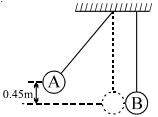
Two massless string of length $5\, m$ hang from the ceiling very near to each other as shown in the figure. Two balls $A$ and $B$ of masses $0.25 \,kg$ and $0.5 \,kg$ are attached to the string. The ball $A$ is released from rest at $a$ height $0.45\, m$ as shown in the figure. The collision between two balls is completely elastic. Immediately after the collision, the kinetic energy of ball $B$ is $1\, J$. The velocity of ball $A$ just after the collision is
An iron ball and a wooden ball of the same radius are released from a height $‘h’$ in vacuum. The time taken by both of them to reach the ground is
The angular momentum of a moving body remains constant if