MCQ
An observer moves with a constant speed along the line joining two stationary objects. He will observe that the two objects
  • A
    have the same speed
  • B
    have the same velocity
  • C
    move in the same direction
  • All of the above

Answer

Correct option: D.
All of the above
d
$V _{\text {rel }}= V _{\text {object }}- V _{\text {frame }}$

Since velocity of both objects is $zero$, thus the relative velocity and speed will be same for both objects also the direction will be the same.

Need a full question paper?

Generate a complete, print-ready paper with questions like this in minutes — across 16+ boards, with answer keys.

Start Generating Free

Similar questions

Statement $I :$ A cyclist is moving on an unbanked road with a speed of $7\, kmh ^{-1}$ and takes a sharp circular turn along a path of radius of $2 \,m$ without reducing the speed. The static friction coefficient is $0.2$ . The cyclist will not slip and pass the curve $\left( g =9.8\, m / s ^{2}\right)$

Statement $II :$ If the road is banked at an angle of $45^{\circ}$, cyclist can cross the curve of $2\, m$ radius with the speed of $18.5\, kmh ^{-1}$ without slipping.

In the light of the above statements, choose the correct answer from the options given below.
At $40\,^oC$, a brass wire of $1\, mm$ is hung from the ceiling. A small mass, $M$ is hung from the free end of the wire. When the wire is cooled down from $40\,^oC$ to $20\,^oC$ it regains its original length of $0.2\, m$. The value of $M$ is close to ........$kg$ (Coefficient of linear expansion and Young's modulus of brass are $10^{-5}/^oC$ and $10^{11}\, N/m^2$, respectively; $g = 10\, ms^{-2}$)
Angular momentum of a single particle moving with constant speed along circular path:
The 'Kangri' is an earthen pot used to stay warm in Kashmir during the winter months. Assume that the 'Kangri' is spherical and of surface area $7 \times 10^{-2} \,m ^{2}$. It contains $300 g$ of a mixture of coal, wood and leaves with calorific value of $30 \,kJ / g$ (and provides heat with $10 \%$ efficiency). The surface temperature of the 'Kangri' is $60^{\circ} C$ and the room temperature is $0^{\circ} C$. Then, a reasonable estimate for the duration $t$ (in h) that the 'Kangri' heat will last is (take the 'Kangri' to be a black body)
The time period of a geostationary satellite is $24\; \mathrm{h}$, at a helght $6 \mathrm{R}_{\mathrm{E}}( \mathrm{R}_{\mathrm{E}}$ is radius of earth) from surface of earth. The time period of another satellite whose helght is $2.5 \mathrm{R}_{\mathrm{E}}$ from surface will be
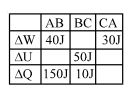
A student records $\Delta Q, \Delta U \& \Delta W$ for a thermodynamic cycle $A$ $\rightarrow$ $B \rightarrow C \rightarrow A$. Certain entries are missing. Find correct entry in following options.
If body having initial velocity zero is moving with uniform acceleration $8\,\,m/{\sec ^2}$ the distance travelled by it in fifth second will be.........$metres$
Which of the following graphs correctly represents the relation between ln $E$ and ln $T$ where $E$ is the amount of radiation emitted per unit time from unit area of a body and $T$ is the absolute temperature
A wire of length $2\, m$ is made from $10\;c{m^3}$ of copper. A force $F$ is applied so that its length increases by $2\, mm.$ Another wire of length 8 m is made from the same volume of copper. If the force $F$ is applied to it, its length will increase by......... $cm$
A block of mass $10\, kg,$ moving in $x$ direction with a constant speed of $10\, m s^{-1}$, is subjected to a retarding force $F= 0.1\,x \,J/m$ during its travel from $x = 20 \,m $ to $30\, m$. Its final $KE$ will be ............... $\mathrm{J}$