Question
An old man cannot see objects closer than 1m from the eye clearly. Name the defect of vision he is suffering from. How can it be corrected? Draw ray diagram for the,
  1. Defect of vision.
  2. For its correction.

Answer


When a person cannot see objects closer than 1m from the eye, he is suffering from presbyopia.

Presbyopia is a common defect of vision, which generally occurs at old age. A person suffering from this type of defect of vision cannot see nearby objects clearly and distinctively. A

presbyopic eye has its near point greater than 25cm and it gradually increases as the eye becomes older.

Presbyopia is caused by the:
  1. Gradual weakening of the ciliary muscles.
  2. Reduction of flexibility in the eye lens.

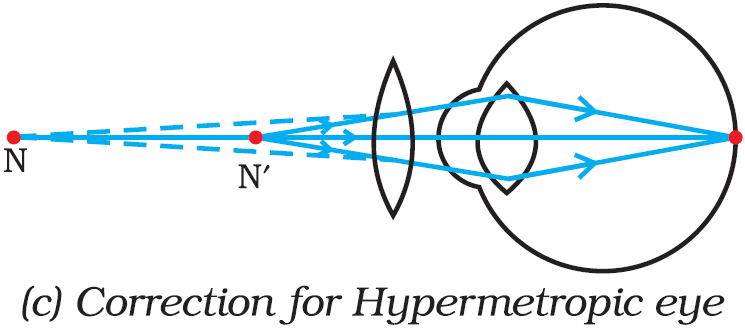
Presbyopia can be corrected by using a convex lens of appropriate power.

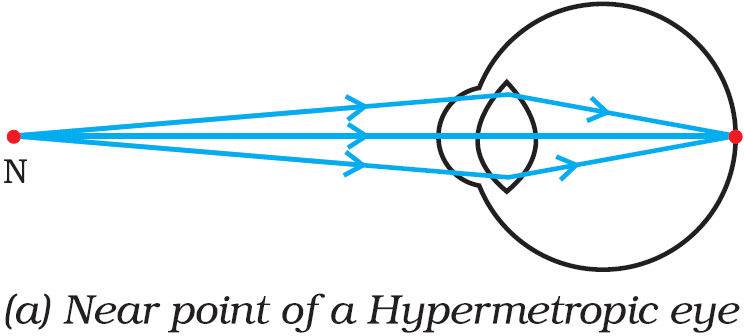
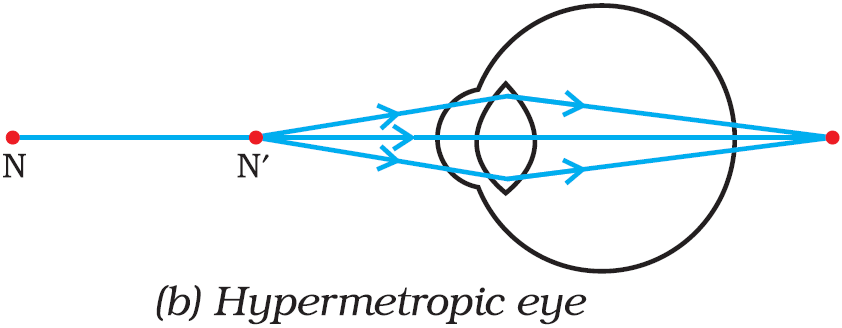
Ray diagram showing presbyopia is as shown below:

Need a full question paper?

Generate a complete, print-ready paper with questions like this in minutes — across 16+ boards, with answer keys.

Start Generating Free

Similar questions

What are the necessary conditions for autotrophic nutrition and what are its byproducts?
An object 2cm tall stands on the principal axis of a converging lens of focal length 8cm. Find the position, nature and size of the image formed if the object is:
  1. 12cm from the lens.
  2. 6 cm from the lens.
Fertilizers and other chemicals used in agriculture are harmful to us. Give reason.
In an experiment to study the scattering of light by passing a beam of white light through a colloidal solution of sulphur in a transparent glass tank:
  1. Which colour is observed from the front of the glass tank? Does this colour correspond to the colour of sky on a clear day or the colour of sky around the sun at sunset?
  2. Which colour is observed from the sides of the glass tank? Does this colour correspond to the colour of sky on a clear day or the colour of sky around the sun at sunset?
Explain with an example for each, how the following provides evidences in favour of evolution in organisms:
  1. Homologous organs.
  2. Analogous organs.
  3. Fossils.
What is the principle of an electric motor? Name some of the devices in which electric motors are used.
How does the tendency to gain electrons change as we go down in group 17 of the periodic table? Why does it change this way?
Explain with the help of a labelled diagram, the cause of twinkling of stars.
The calorific values of three fuels A, B and C are 33kJ/ g, 48kJ/ g and 150kJ/ g, respectively. A is solid, B is liquid and C is a gas at room temperature. One combustion, both A and B produce carbon dioxide while C explodes forming steam. B and C leave no residue after combustion while A leaves behind some solid residue. Which one of the three fuels is the most ideal? Give two reasons to support your answer.
Salt A commonly used in bakery products on heating gets converted into another salt B which itself is used for removal of hardness of water and a gas C is evolved. The gas C when passed through lime water, turns it milky. Identify A, B and C.