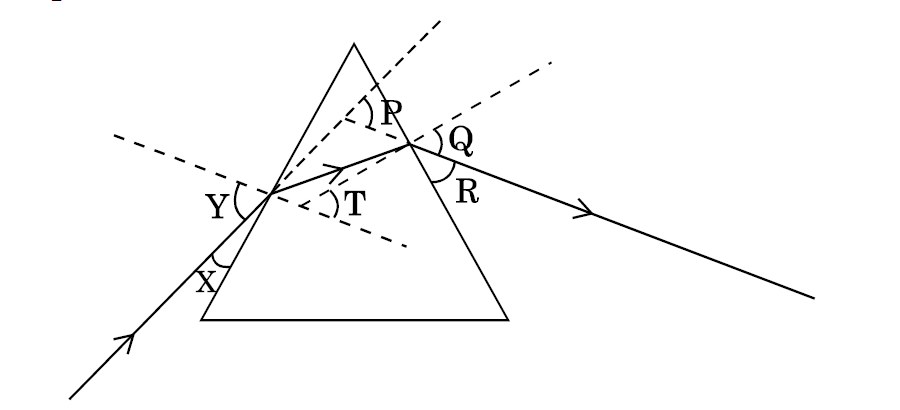
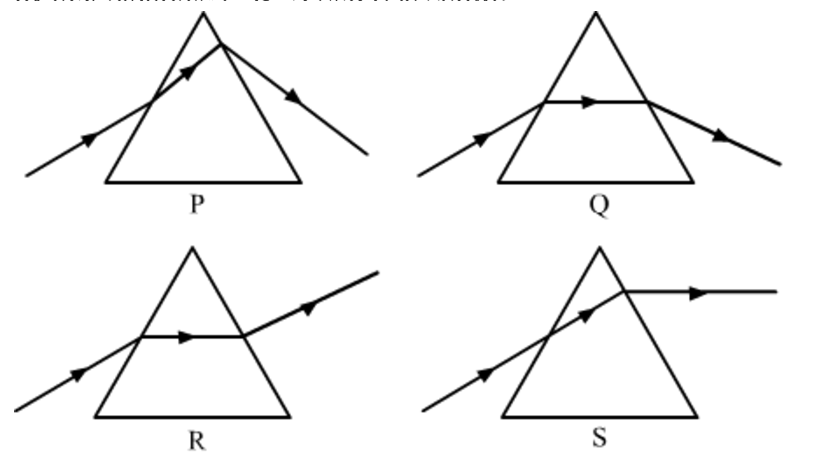
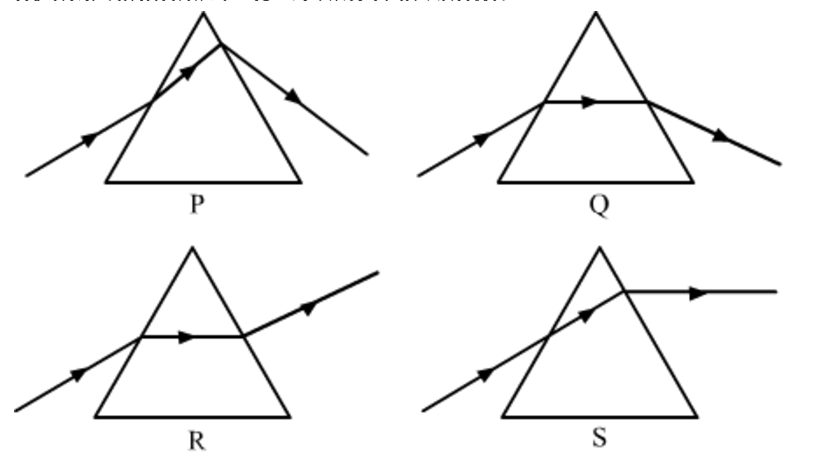
In this diagram the angle of incidence, the angle of emergence and the angle of deviation respectively are $($select the correct option$) :$
- A$X, R$ and $T.$
- B$Y, Q$ and $T.$
- C$X, Q$ and $P.$
- ✓$Y, Q$ and $P.$
Answer: D.
View full solution →1,180 questions across 18 question groups — pick any mix to generate a Science paper with step-by-step answer keys.
M.C.Q
202 Q→02Assertion - Reasoning (1 Marks)
13 Q→03Fill in the blank
21 Q→04True-False
6 Q→05[1 Mark Questions]
122 Q→06[2 Mark Questions]
106 Q→07[3 Mark Questions]
84 Q→08[5 marks Questions]
36 Q→09case /data -based (4 Marks)
8 Q→10M.C.Q-[Phy-1M]
186 Q→11Assertion - Reasoning [Phy-1 M]
13 Q→12Fill in the blank [Phy-1M]
21 Q→13True-False [Phy-1M]
6 Q→14Answer the questions.[Phy-1M]
122 Q→15Answer the questions.[Phy-2M]
106 Q→16Answer the questions.[Phy-3M]
84 Q→17case /data -based [Phy-4M]
8 Q→18Answer the questions.[Phy-5M]
36 Q→One sample from each question group in this chapter. Select any group above to see the full set with answer keys.

Answer: D.
View full solution →
Answer: B.
View full solution →
Answer: D.
View full solution →
Answer: B.
View full solution →
Answer: C.
View full solution →Answer: A.
View full solution →Answer: B.
View full solution →(i) Find the focal length of his distant viewing part of lens.
(ii) Find the focal length of near vision section of the lens.
(iii) What type of lens is to be used in this spectacles for near vision?
or
(iv) What is the reason of hypermetropia?
For all the calculations required you can use the lens formula and lens maker's formula. Assume that the eye lens is equiconvex lens. Neglect the distance between eye lens and the spectacle lens.
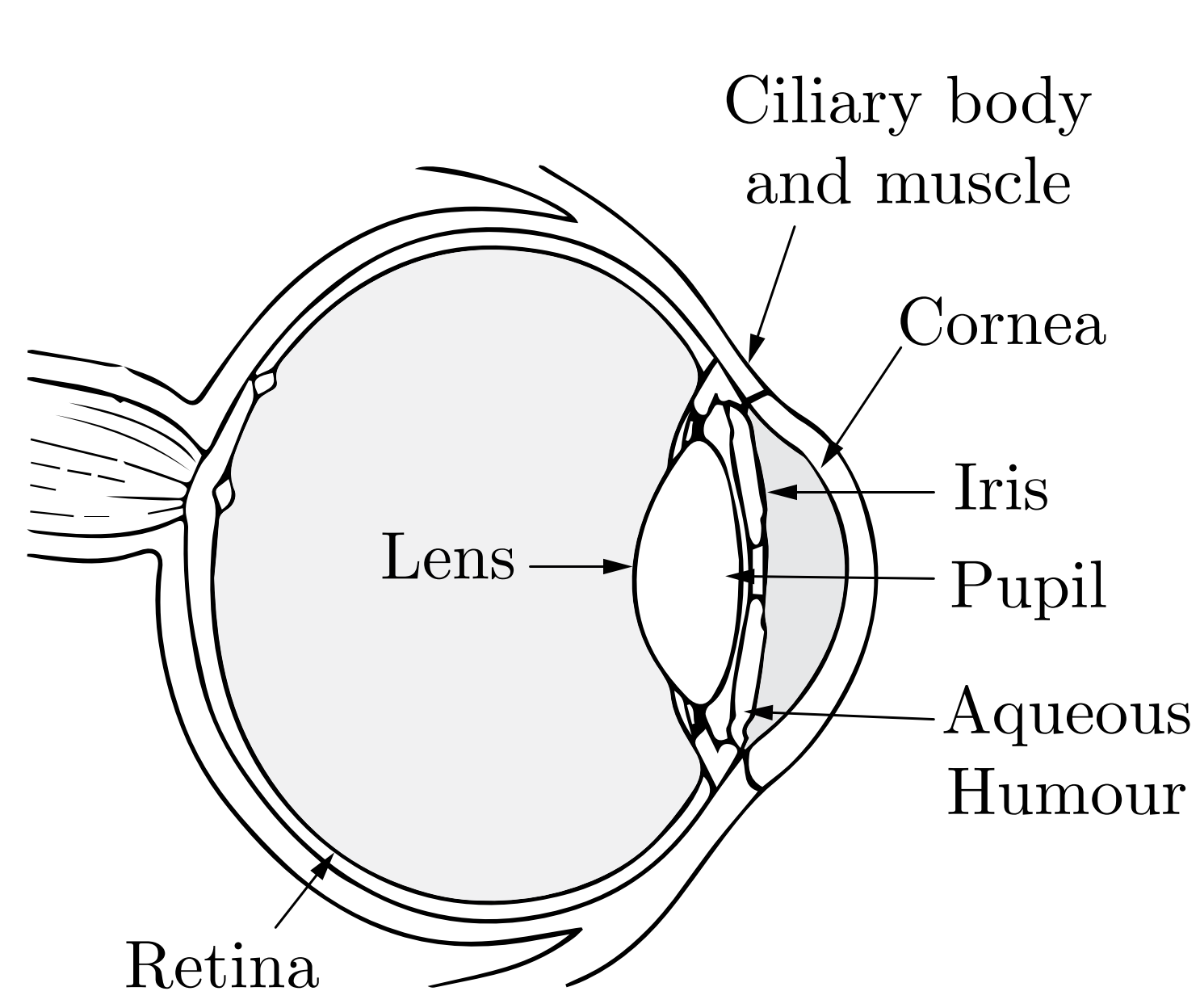
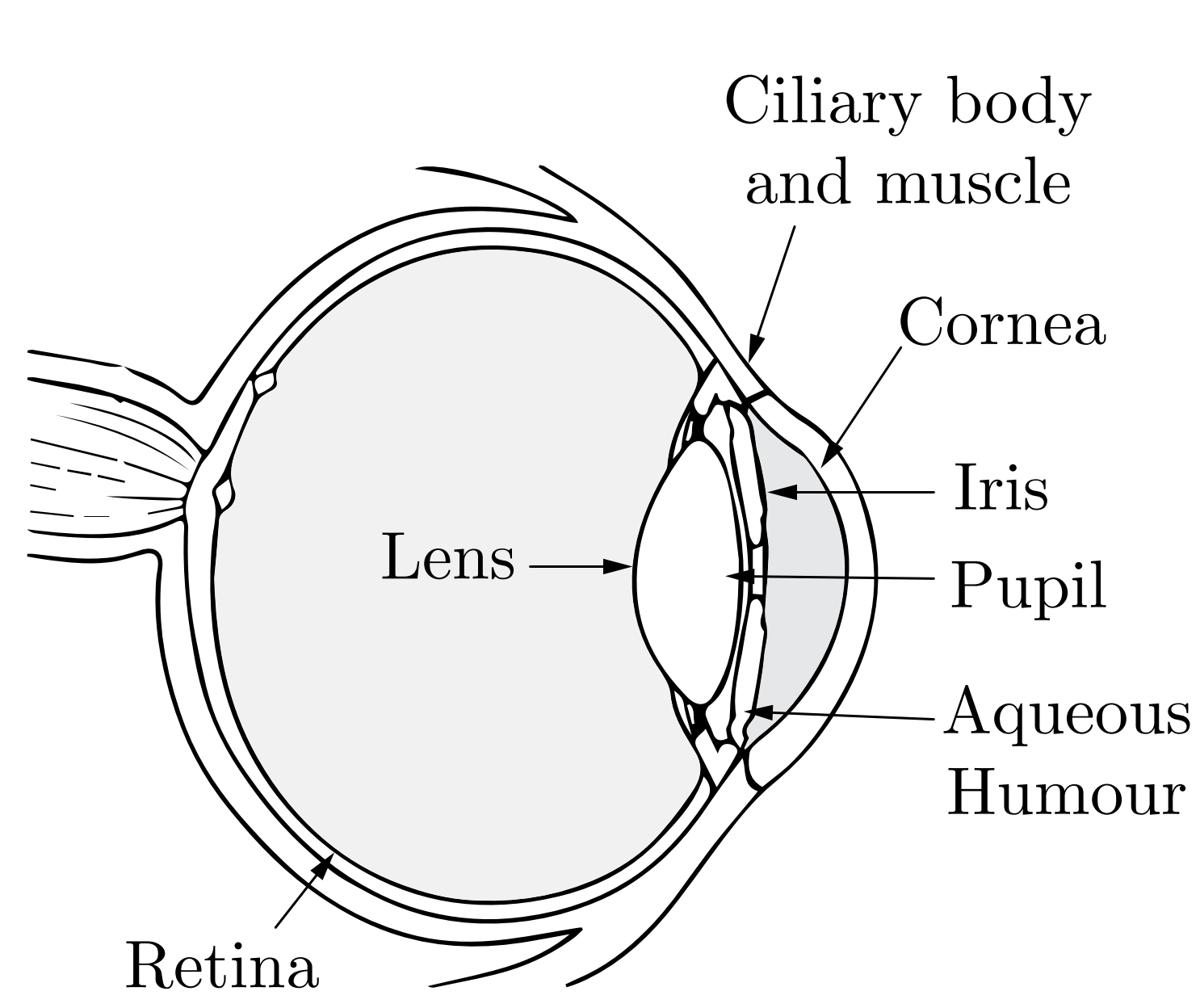
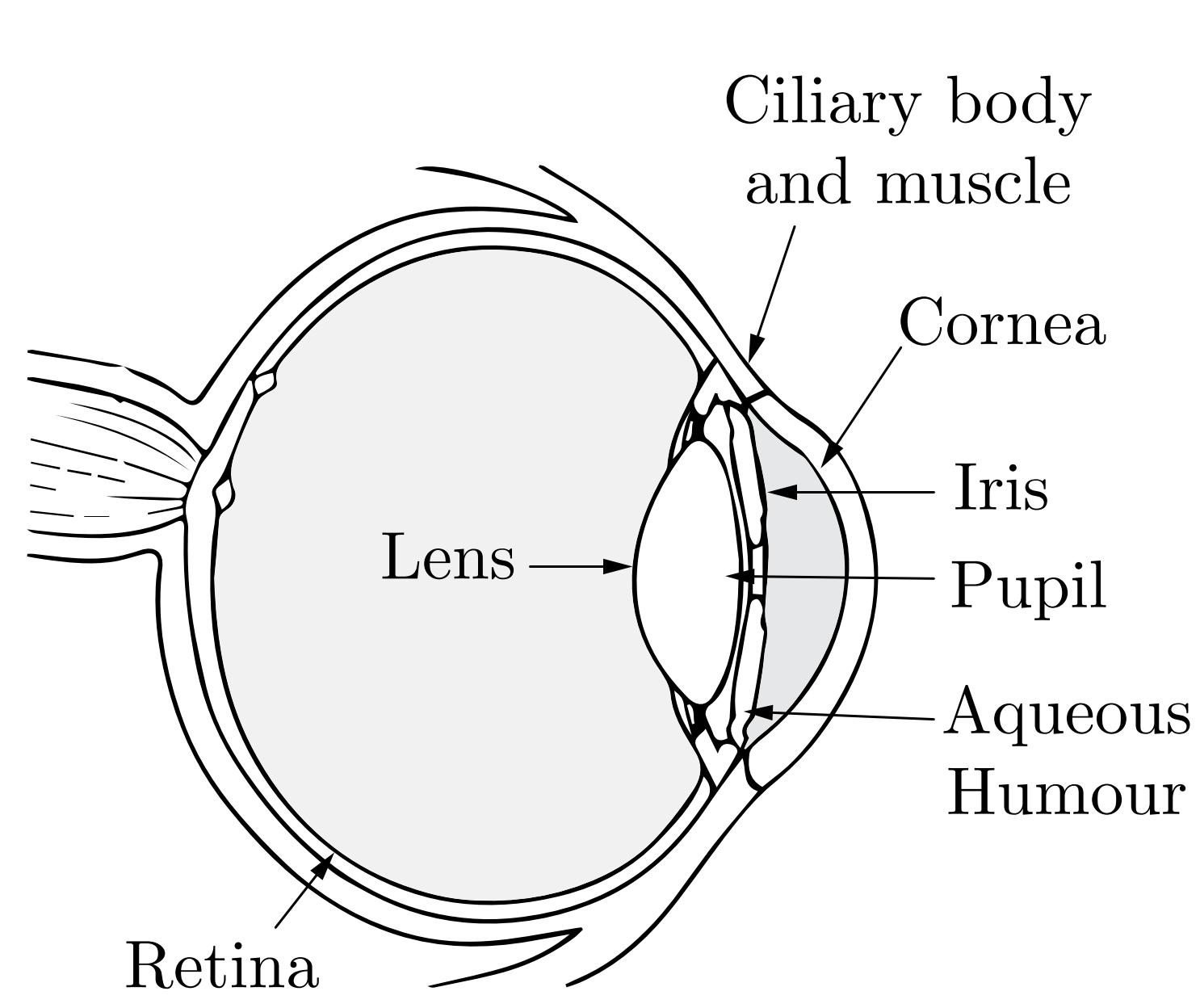
(i) What do you mean by the ciliary muscles?
(ii) What is the minimum focal length of eye lens of a normal person ?
(iii) What is the maximum focal length of eye lens of normal person ?
or
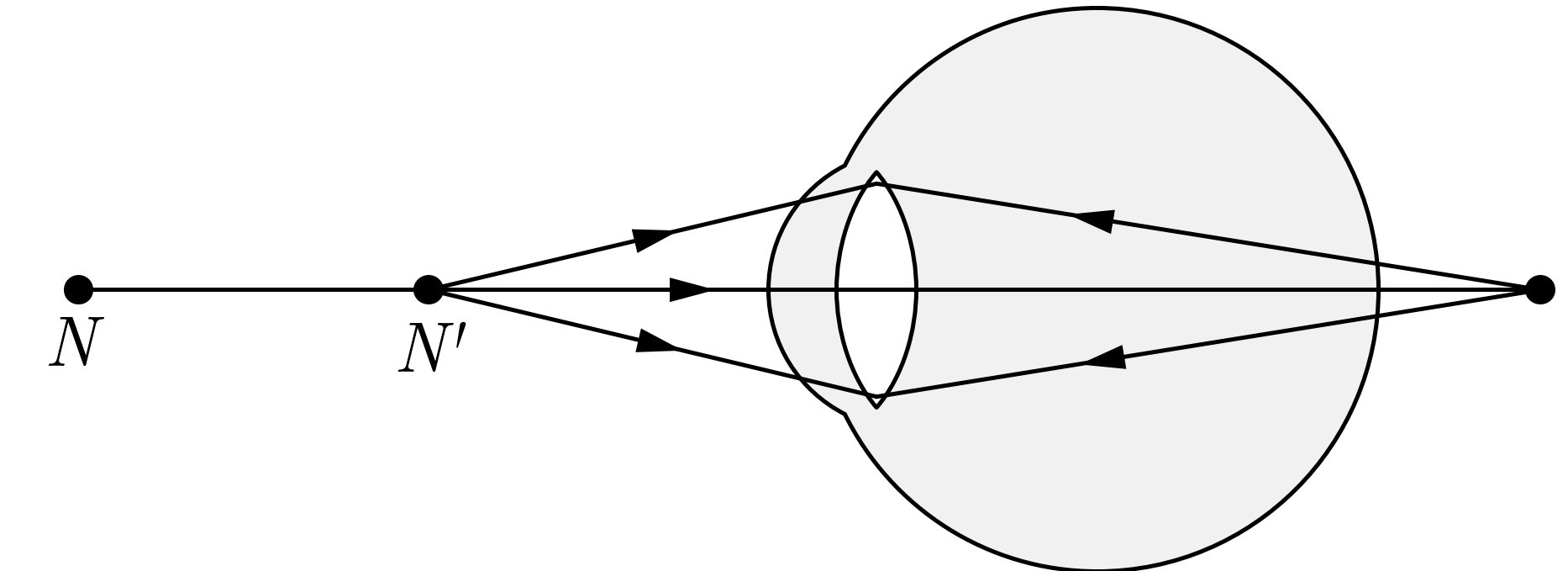
(iv) A near-sighted man can clearly see object only up-to a distance of $100 cm$ and not beyond this. What is the number of the spectacles lens necessary for the remedy of this defect ?
There are mainly three common refractive defects of vision. These are (i) myopia or near-sightedness, (ii) hypermetropia or far-sightedness, and (iii) Presbyopia. These defects can be corrected by the use of suitable spherical lenses.
(i) What is the function of pupil in the human eye ?
(ii) What is the far point and near point of human eye with normal vision?
(iii) A student has difficulty reading the blackboard while sitting in the last row. What could be the defect the child is suffering from?
(iv) What is the function of iris in human eye ?
(i) What type of lens should be used in his spectacles?
(ii) What should be the focal length of the lens he used?
(iii) What will be the potver of the lens?
or
(iv) Write one possible cause of this defect.

The spreading of light by the air molecules is called scattering of light. The light having least wavelength scatters more. The sun appears red at sunrise and sunset, appearance of blue sky it is due to the scattering of light. The colour of the scattered light depends on the size of particles. The smaller the molecules in the atmosphere scatter smaller wavelengths of tight. The amount of scattering of light depends on the wavelength of light. When light from sun enters the earth's atmosphere, it gets scattered by the dust particles and air molecules present in the atmosphere. The path of sunlight entering in the dark room through a fine hole is seen because of scattering of the sun light by the dust particles present in its path inside the room.

Pick question groups from the list above, set marks and difficulty, and export a branded PDF with step-by-step answer keys. First 3 chapters free — no signup.