Question
An open mouthed vessel is filled with air at $60^{\circ} C$. To what temperature should the vessel be heated so that $\frac{1}{4}$ part of air comes out?

Answer

Suppose initially there are n molecules in the vessel while the absolute temperature of gas is $T_1 K$. On heating till $T _2 K \frac{1}{4}$ molecules come out hence the reamining molecule :
$\begin{aligned}& n^{\prime}=n-\frac{1}{4} n=\frac{3}{4} n \\\because \quad nT_1 & =n^{\prime} T_2 \Rightarrow \frac{n}{n^{\prime}}=\frac{T_2}{T_1} \\\frac{3}{\frac{3}{4} n} & =\frac{T_2}{273+60}=\frac{T_2}{333} \\\Rightarrow \quad \frac{4}{3} & =\frac{T_2}{333} \quad \therefore T_2=\frac{4 \times 333}{3} \Rightarrow T_2=444 K \\\therefore\quad T_2 & =444-273=171^{\circ} C\end{aligned} $

Need a full question paper?

Generate a complete, print-ready paper with questions like this in minutes — across 16+ boards, with answer keys.
Start Generating Free

Similar questions

Two syringes of different cross$-$sections $($without needles$)$ filled with water are connected with a tightly fitted rubber tube filled with water. Diameters of the smaller piston and larger piston are $1.0\ cm$ and $3.0\ cm$ respectively.
  1. Find the force exerted on the larger piston when a force of $10N$ is applied to the smaller piston.
  2. If the smaller piston is pushed in through $6.0\ cm$, how much does the larger piston move out?
The angle between vectors A and B is 60°. What is the ratio of A.B and |A × B|?
A man walks on a straight road from his home to a market 2.5 km away with a speed of $5 \mathrm{~km}{ }^{\mathrm{h}-1}$. Finding the market closed, he instantly turns and walks back home with a speed of $7.5 \mathrm{~km} \mathrm{~h}^{-1}$. What is the Magnitude of average velocity, and.
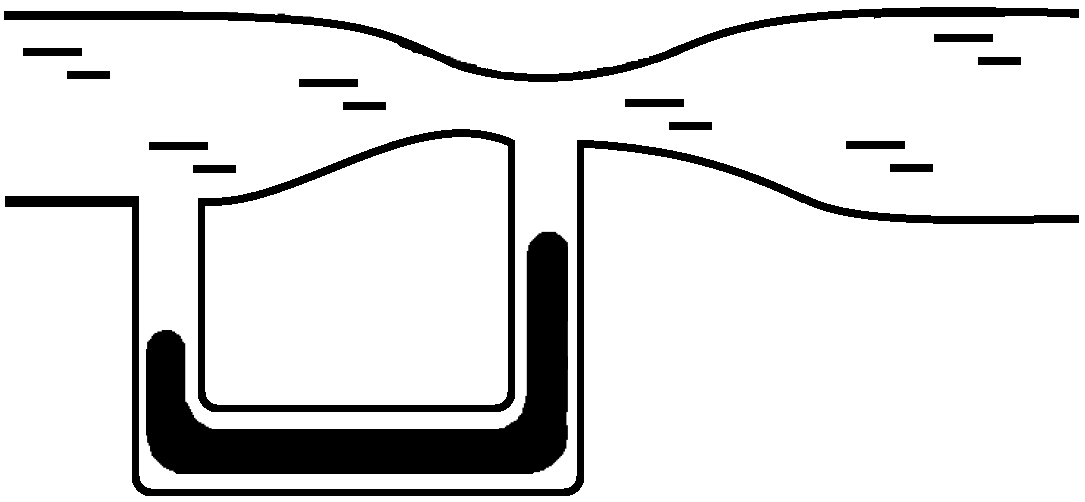
Water flows through the tube shown in The areas of cross-section of the wide and the narrow portions of the tube are $5 \mathrm{~cm}^2$ and $2 \mathrm{~cm}^2$ respectively. The rate of flow of water through the tube is $500 \mathrm{~cm}^3 / \mathrm{s}$. Find the difference of mercury levels in the U-tube.
Show that the internal energy of the air (treated as an ideal gas) contained in a room remains constant as the temperature changes between day and night. Assume that the atmospheric pressure around remains constant and the air in the room maintains this pressure by communicating with the surrounding through the windows, doors, etc.
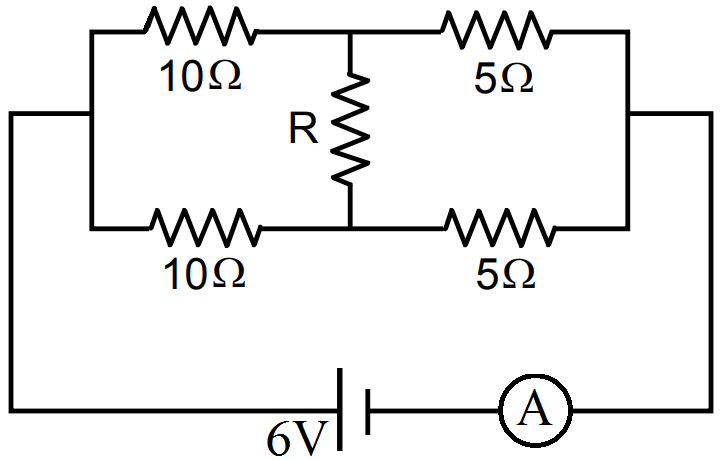
What should be the value of R in the figure. for which the current in it is zero?
The average speed of a snail is 0.020 miles/hour and that of a leopard is 70 miles/hour. Convert these speeds in SI units.
If the simple pendulum (including the base) start falling freely, then what will be the period of oscillation? Give positive reason.
The temperatures of the junctions of a bismuth-silver thermocouple are maintained at $0^{\circ} \mathrm{C}$ and $0.001^{\circ} \mathrm{C}$. Find the thermo-emf (Seebeck emf) developed. For bismuth-silver, $a=-46 \times 10^{-6} \mathrm{~V}^{\circ} \mathrm{C}-^{-1}$ and $\mathrm{b}=-0.48 \times 10^{-6} \mathrm{~V}^{\circ} \mathrm{C}^{-2}$.
A body hanging from a spring can oscillate in a horizontal plane with angular velocity $\omega$ without friction or damping when it is stretched to a distance and then released. It passes through the equilibrium center with a velocity at time $t=0$. Find the amplitude of the resultant oscillation in terms of parameter $\omega_0, x_0$ and $v_0$.
[Hint : The equation $x=a \cos (\omega t+\theta)$ is negative keep in mind that the initial]