An open pipe of length $33\, cm$ resonates to a frequency of $1000\,Hz$. The mode of vibration is: (velocity of sound $= 330\, m/s$)
Medium


Download our appand get started for free
Experience the future of education. Simply download our apps or reach out to us for more information. Let's shape the future of learning together!No signup needed.*
Similar Questions
- 1Two sources of sound $S_1$ and $S_2$ produce sound waves of same frequency $660\, Hz$. A listener is moving from source $S_1$ towards $S_2$ with a constant speed $u\, m/s$ and he hears $10\, beats/s$. The velocity of sound is $330\, m/s$. Then, $u$ equals ... $m/s$View Solution
- 2The velocity of sound in a gas. in which two wavelengths $4.08\,m$ and $4.16\,m$ produce $40$ beats in $12\,s$, will be ..............$ms ^{-1}$View Solution
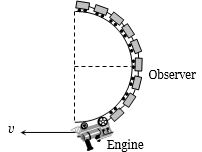
- 3A train has just complicated a $U-$curve in a track which is a semicircle. The engine is at the forward end of the semi circular part of the track while the last carriage is at the rear end of the semicircular track. The driver blows a whistle of frequency $200 Hz.$ Velocity of sound is $340 m/sec$. Then the apparent frequency as observed by a passenger in the middle of a train when the speed of the train is $30 m/sec$ is ... $Hz$View Solution
- 4A wave is given by $y = 3\sin 2\pi \left( {\frac{t}{{0.04}} - \frac{x}{{0.01}}} \right)$, where $y$ is in $cm$. Frequency of wave and maximum acceleration of particle will beView Solution
- 5Answer the following by appropriately matching the lists based on the information given in the paragraph.A musical instrument is made using four different metal strings, $1,2,3$ and $4$ with mass per unit length $\mu, 2 \mu, 3 \mu$ and $4 \mu$ respectively. The instrument is played by vibrating the strings by varying the free length in between the range $L _0$ and $2 L _0$. It is found that in string$-1 \ (\mu)$ at free length $L _0$ and tension $T _0$ the fundamental mode frequency is $f _0$.View Solution
List $-I$ gives the above four strings while list $-II$ lists the magnitude of some quantity.
($1$) If the tension in each string is $T _0$, the correct match for the highest fundamental frequency in $f _0$ units will be,List $-I$ List $-II$ $(I)$ String $-1( \mu$ ) $(P) 1$ $(II)$ String $-2 (2 \mu)$ $(Q)$ $1 / 2$ $(III)$ String $-3 (3 \mu)$ $(R)$ $1 / \sqrt{2}$ $(IV)$ String $-4 (4 \mu)$ $(S)$ $1 / \sqrt{3}$ $(T)$ $3 / 16$ $(U)$ $1 / 16$
$(1)$ $I \rightarrow P , II \rightarrow R , III \rightarrow S , IV \rightarrow Q$
$(2)$ $I \rightarrow P , II \rightarrow Q , III \rightarrow T , IV \rightarrow S$
$(3)$ $I \rightarrow Q , II \rightarrow S , III \rightarrow R , IV \rightarrow P$
$(4)$ I $\rightarrow Q , II \rightarrow P , III \rightarrow R$, IV $\rightarrow T$
($2$) The length of the string $1,2,3$ and 4 are kept fixed at $L _0, \frac{3 L _0}{2}, \frac{5 L _0}{4}$ and $\frac{7 L _0}{4}$, respectively. Strings $1,2,3$ and 4 are vibrated at their $1^{\text {tt }}, 3^{\text {rd }}, 5^{\text {m }}$ and $14^{\star}$ harmonics, respectively such that all the strings have same frequency. The correct match for the tension in the four strings in the units of $T _0$ will be.
$(1)$ $I \rightarrow P , II \rightarrow Q , III \rightarrow T , IV \rightarrow U$
$(2)$ $I \rightarrow T , II \rightarrow Q , III \rightarrow R$, IV $\rightarrow U$
$(3)$ $I \rightarrow P , II \rightarrow Q , III \rightarrow R , IV \rightarrow T$
$(4)$ I $\rightarrow P , II \rightarrow R , III \rightarrow T , IV \rightarrow U$ - 6The driver of a car travelling with speed $30$ metres per second towards a hill sounds a horn of frequency $600 Hz$. If the velocity of sound in air is $330$ metres per second, the frequency of the reflected sound as heard by the driver is .... $Hz$View Solution
- 7View SolutionQuality of a musical note depends on
- 8An open pipe of length $33\,cm$ resonates to a frequency of $1000\,Hz$ . The mode of vibration is: (velocity of sound $= 330\,m/s$ )View Solution
- 9For the stationary wave $y = 4\sin \,\left( {\frac{{\pi x}}{{15}}} \right)\cos (96\,\pi t)$, the distance between a node and the next antinode isView Solution
- 10A source of sound gives five beats per second when sounded with another source of frequency $100\,{s^{ - 1}}$. The second harmonic of the source together with a source of frequency $205\,{s^{ - 1}}$ gives five beats per second. What is the frequency of the source .... ${s^{ - 1}}$View Solution