Question
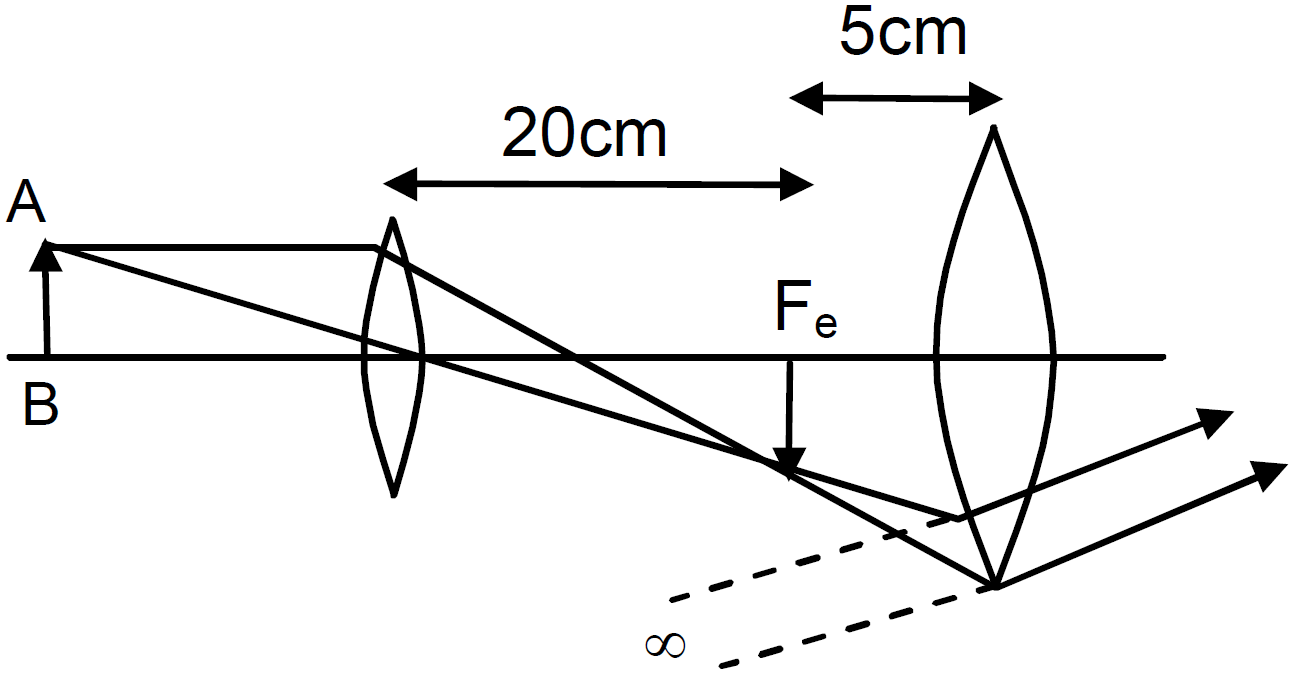
An optical instrument used for angular magnification has a $25D$ objective and a $20D$ eyepiece. The tube length is $25\ cm$ when the eye is least strained.
  1. Whether it is a microscope or a telescope?
  2. What is the angular magnification produced?
Answer

The optical instrument has $\text{f}_0=\frac{1}{25\text{D}}=0.04\text{m}=4\text{cm}$
$\text{f}_\text{e}=\frac{1}{20\text{D}}=0.05\text{m}=5\text{cm}$
tube length $= 25\ cm\ ($normal adjustment$)$
  1. The instrument must be a microscope as $f_0< f_e$
  2. Since the final image is formed at infinity, the image produced by the objective should lie on the focal plane of the eye piece.
So, image distance for objective $= v_0 = 25 – 5 = 20\ cm$
Now, using lens formula.
$\frac{1}{\text{v}_0}-\frac{1}{\text{u}_0}=\frac{1}{\text{f}_0}$
$\Rightarrow\frac{1}{\text{u}_0}=\frac{1}{\text{v}_0}-\frac{1}{\text{f}_0}=\frac{1}{20}-\frac{1}{4}$
$=\frac{-4}{20}=\frac{-1}{5}\Rightarrow\text{u}_0=-5\text{cm}$
So, angular magnification $\text{m}=-\frac{\text{v}_0}{\text{u}_0}\times\frac{\text{D}}{\text{f}_\text{e}}\ [$Taking $D = 25\ cm]$
$=-\frac{20}{-5}\times\frac{25}{5}=20$

Need a full question paper?

Generate a complete, print-ready paper with questions like this in minutes — across 16+ boards, with answer keys.

Start Generating Free

Similar questions

A glass surface is coated by an oil film of uniform thickness $1.00 \times 10^{-4}cm.$ The index of refraction of the oil is $1.25$ and that of the glass is $1.50.$ Find the wavelengths of light in the visible region $(400\ nm - 750\ nm)$ which are completely transmitted by the oil film under normal incidence.
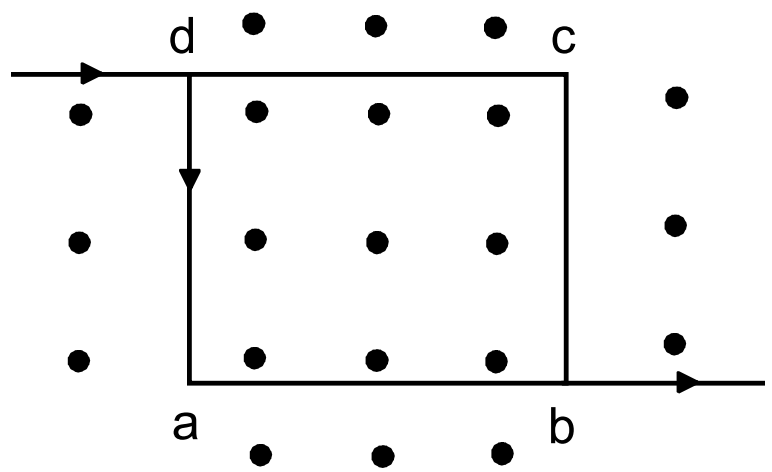
A current of 2A enters at the corner d of a square frame abcd of side 20cm and leaves at the opposite corner b. A magnetic field B = 0.1 T exists in the space in a direction perpendicular to the plane of the frame, as shown in the figure. Find the magnitude and direction of the magnetic forces on the four sides of the frame.
A small town with a demand of $800\ \text{kW}$ of electric power at $220V$ is situated $15\ km$ away from an electric plant generating power at $440V.$ The resistance of the two wire line carrying power is $0.5\Omega$ per $ km.$ The town gets power from the line through a $4000-220V$ step$-$down transformer at a sub$-$station in the town.
  1. Estimate the line power loss in the form of heat.
  2. How much power must the plant supply, assuming there is negligible power loss due to leakage?
  3. Characterise the step up transformer at the plant.
Consider a thin target $(10^{-2}m^2 ,  10^{-3}m$ thickness$)$ of sodium, which produces a photocurrent of $100\mu A$ when a light of intensity $100W/m^2 (\lambda = 660nm)$ falls on it. Find the probability that a photoelectron is produced when a photons strikes a sodium atom. $[$Take density of Na $= 0.97 \ kg/m^3].$
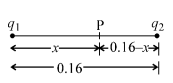
Two charges of$5 \times 10^{-8} C$ and $-3 \times 10^{-8}$ are located at a distance of 16 cm apart. At what point on the line joining the two charges is the electric potential zero? Take the potential at infinity to be zero.
Image
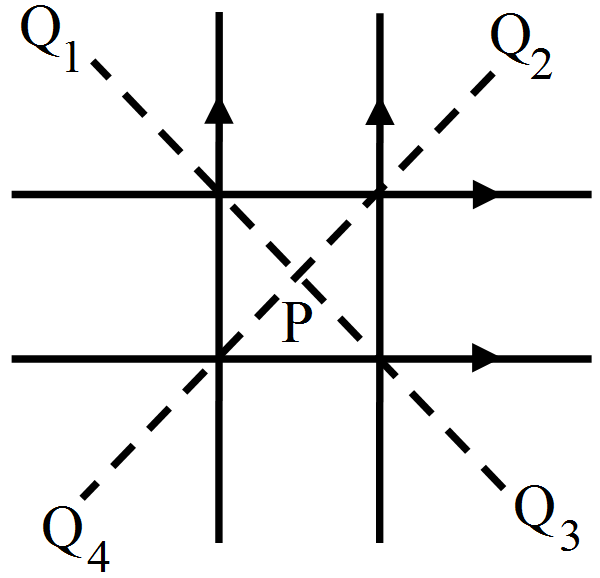
Four long, straight wires, each carrying a current of $5.0A,$ are placed in a plane as shown in figure. The points of intersection form a square of side $5.0\ cm.$
  1. Find the magnetic field at the centre $P$ of the square.
  2. $Q_1, Q_2, Q_3,$ and $Q_4$ are points situated on the diagonals of the liquare and at a distance from $P$ that is equal to the length of the diagonal of the square. Find the magnetic fields at these points.
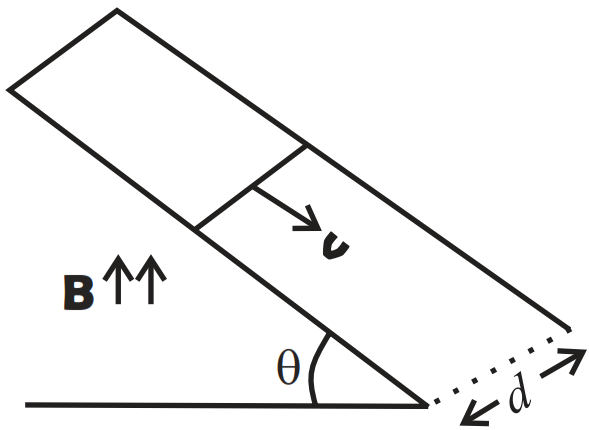
A rod of mass m and resistance $R$ slides smoothly over two parallel perfectly conducting wires kept sloping at an angle $\theta$ with respect to the horizontal $($Fig$)$. The circuit is closed through a perfect conductor at the top. There is a constant magnetic field $B$ along the vertical direction. If the rod is initially at rest, find the velocity of the rod as a function of time.
What is Zener diode? Give its symbolic diagram. Draw its (I-V) characteristic curve. Explain its use as a voltage regulator ?
A conducting square loop having edges of length 2.0cm is rotated through 180° about a diagonal in 0.20s. A magnetic field B exists in the region which is perpendicular to the loop in its initial position. If the average induced emf during the rotation is 20mV, find the magnitude of the magnetic field.
Describe Davisson and Germer’s experiment to demonstrate the wave nature of electrons. Draw a labelled diagram of apparatus used.